Quick answer: what are bronze casting defects?
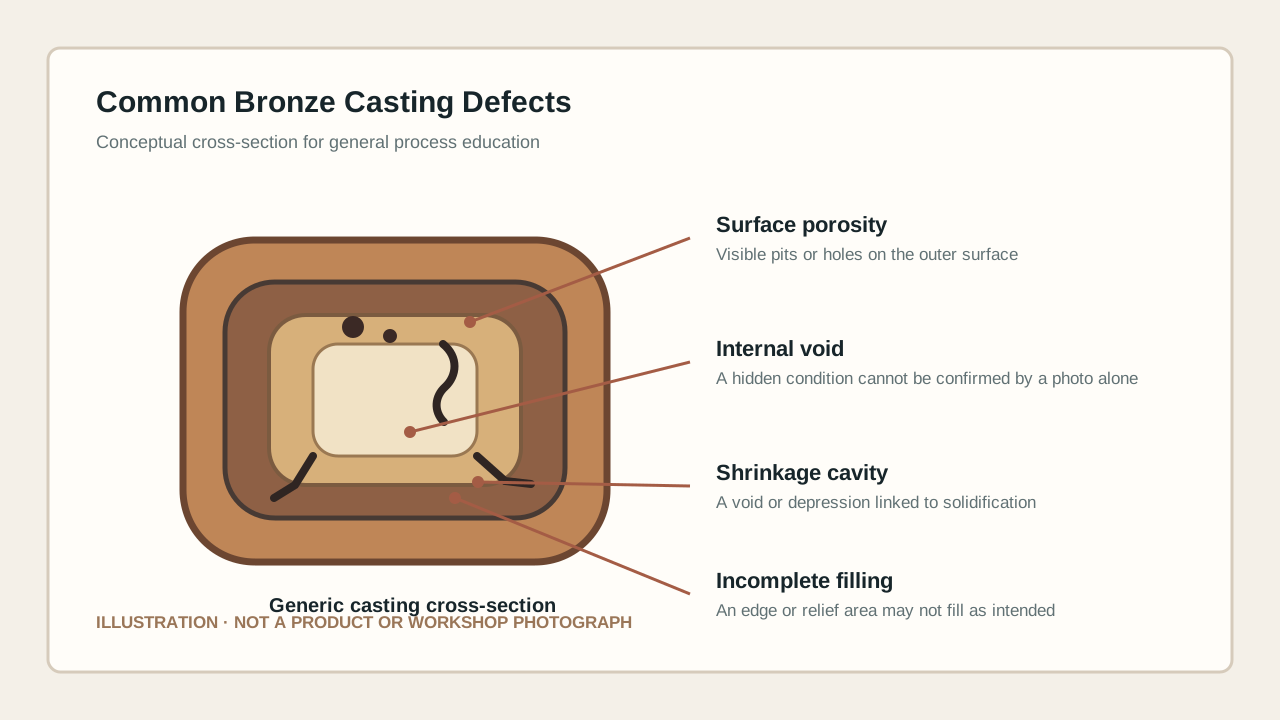
Bronze casting defects are unwanted flaws or inconsistencies that may appear during mold preparation, metal filling, solidification, cooling, cleaning or finishing. Common examples include porosity, shrinkage cavities, inclusions, incomplete filling and surface defects.
The visible symptom can suggest a defect category, but it does not always prove the exact cause. A surface mark may relate to casting, finishing, repair, handling or patina. For a modern bronze reproduction, the responsible approach is to connect the visible condition with product-specific photographs, dimensions, sample information and quality questions.
General process education: This guide explains common casting concepts. It does not claim that every modern bronze reproduction uses the same process or that a photograph can prove the complete production history of an object.
Common types of bronze casting defects
| Defect category | What it may look like | What buyers should remember |
|---|---|---|
| Porosity | Small holes, pits or voids, either visible on the surface or hidden inside. | A close-up can show a surface condition, but not the full internal structure. |
| Shrinkage | A depression, cavity or discontinuity related to contraction during solidification. | Geometry and cooling behavior affect the location and appearance. |
| Inclusions | An unwanted particle, spot or embedded material. | A dark spot is not automatically an inclusion; surface treatment can look similar. |
| Incomplete filling | A missing edge, incomplete relief or discontinuity where metal did not fill as intended. | Flow and filling terms vary; do not diagnose from one photograph alone. |
| Surface defect | Roughness, cracks, joins, cleaning marks or uneven areas. | Cleaning, repair, polishing and patina may change the final appearance. |
Porosity and gas-related holes
Porosity describes unwanted holes or voids in a casting. Some pores may be visible on the surface, while others remain inside the metal and require a more detailed inspection to detect.
For buyers, separate two questions: Can a hole be seen? and What caused it? The first may be answered with a close-up image. The second may require information about the mold, metal flow, solidification and finishing stages. A photograph alone is not enough to identify internal porosity or assign responsibility for it.
Shrinkage cavities and shrinkage porosity
Metal contracts as it cools and solidifies. If liquid metal cannot adequately feed a contracting area, a void or depression may remain. This is commonly discussed as shrinkage or shrinkage porosity.
The location and appearance of a shrinkage-related problem depend on the geometry of the object and the casting system. A thick section, a junction between forms or an area that cools differently from the surrounding metal may need closer attention. A general article can explain the principle, but cannot give one universal visual rule for every bronze vessel.
Inclusions, cold shuts and incomplete filling
Inclusions are unwanted particles or non-metallic material within a casting. When a buyer sees a dark spot, line or embedded particle, it should not automatically be labeled an inclusion. The same appearance could relate to surface treatment, cleaning, repair or photography.
Casting metal must flow into the mold and meet the intended shape before it solidifies. If separate flow fronts do not join properly, or if the cavity is not filled completely, the result may appear as a line, incomplete edge, missing relief or other discontinuity. These terms are not interchangeable in every foundry or educational source, so public-facing content should explain the general filling problem rather than present a diagnosis from a photograph.
Why can casting defects happen?
Casting defects can be connected to more than one stage of production:
- Mold and core preparation: The mold or core establishes the shape and the space that the metal must fill.
- Metal flow and filling: The metal must enter and move through the mold, and geometry influences how different areas fill.
- Solidification and cooling: Metal changes as it loses heat, and uneven contraction can contribute to voids or distortion.
- Cleaning and finishing: Cutting, grinding, polishing, repair and patina can change the visible surface after casting.
This framework is useful for asking better questions, but it is not a substitute for a product-specific technical report. Alloy, geometry, mold design and finishing decisions all matter.
Visible signs versus confirmed diagnosis
| A photograph may show | A photograph cannot prove by itself |
|---|---|
| Surface pits, visible holes or uneven areas | Internal porosity or the full depth of a void |
| An incomplete edge or missing relief | The exact cause of incomplete filling |
| A line, join or surface boundary | Whether the mark comes from casting, finishing or repair |
| Discoloration or a dark spot | Alloy composition or surface-treatment history |
| A crack-like mark | Whether the condition is structural without closer inspection |
This distinction is important when comparing a historical object, a reference image and a modern bronze reproduction. Similar appearance does not prove identical production method, age, workshop or material composition.
How to inspect a modern bronze reproduction
Check the overall form
Compare the current sample with the approved reference. Look at proportions, openings, handles, feet, relief and the relationship between major parts.
Check edges and relief
Raised decoration and thin edges can be visually important. Request close-up images when a design depends on fine relief, sharp transitions or an even rim.
Check the base and assembly points
Confirm that the object sits as intended and that lids, handles or other parts align with the current version. Pair these observations with confirmed dimensions.
Check the surface consistently
Look under more than one lighting condition if possible. Surface color, patina and reflection can change with lighting and photography. Do not treat every color variation as a casting defect.
For broader purchasing preparation, read the Chinese bronze decor sourcing guide and the bronze incense burner wholesale guide.
Questions buyers can ask suppliers
- Which areas of the current sample should be checked most closely?
- Can you provide close-up images of the base, rim, relief and assembly points?
- Which surface differences are expected from the requested finish, and which require review?
- Are the dimensions shown for the current version or an earlier reference?
- Which process details are confirmed for this product, and which are general casting education?
- What should be checked when the package arrives?
Designers can also review the interior designers buyer guide, while small-batch purchasers can use the wholesale and small-batch buyer guide. Trade buyers can also start with the Trade Buyers overview when the question involves a project or repeat order.
Bronze casting defects and related process guides
For historical mold context, read piece-mold casting in ancient Chinese bronzes. For a general process explanation, see the lost-wax bronze casting process guide.
Surface appearance has its own vocabulary, so the bronze patina and surface finishing guide should be read alongside this article. Patina or finishing variation is not automatically evidence of a casting defect.
For a project-specific question about modern Chinese bronze reproductions made today, request a bronze reproduction quote.
Frequently asked questions
What is the most common bronze casting defect?
There is no single defect that is most common for every bronze casting. Porosity, shrinkage, inclusions, incomplete filling and surface problems are all discussed in casting education, but risk depends on the object, material, mold and process.
Can porosity be seen from the outside?
Some pores may be visible, but internal porosity may not be visible in a normal photograph. A close-up can document a surface condition, but it cannot establish the full internal structure.
Does a surface mark prove a casting defect?
No. A surface mark may come from casting, cleaning, trimming, repair, patina or lighting. Product-specific review is needed before assigning a cause.
How should buyers inspect a bronze reproduction?
Start with the approved reference, overall form, dimensions, edges, relief, base, assembly points and surface consistency. Request close-up images and ask which details are confirmed for the current sample.
Sources and further reading
- OpenLearn: Casting microstructure and defects
- Foundry Management & Technology: Reducing foundry scrap and controlling porosity
This article is general process and buyer education. It does not present an illustration as a product photograph, a workshop photograph or proof of a specific CCLYF production method.