
Quick answer: what is piece mold casting?
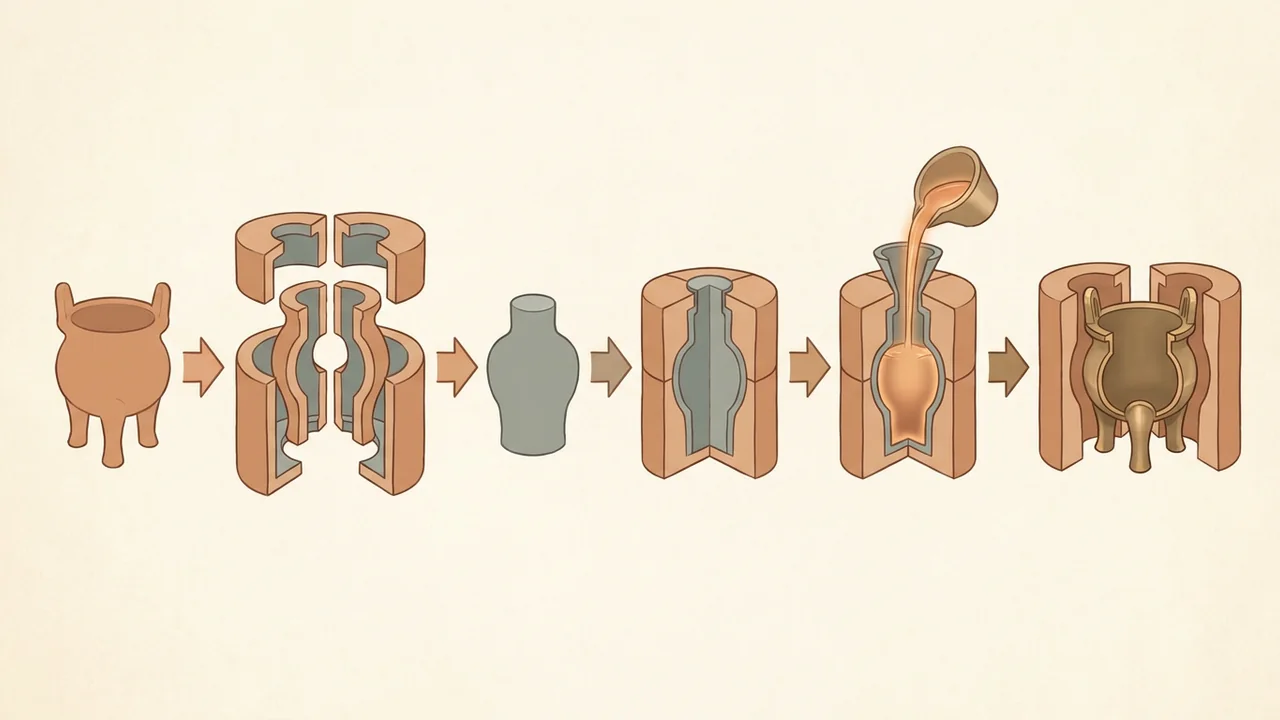
Piece mold casting is a bronze-casting method built around a clay model, several fitted outer mold sections and, for a hollow vessel, an inner core. The mold sections preserve the outside form while the core helps define the inside space. When the mold is assembled, molten bronze fills the cavity between the outer mold and core. After the metal cools, the mold is opened and the casting can be cleaned and finished.
The method is often discussed in relation to early Chinese bronzes, including Shang and Zhou ritual vessels. The historical details varied by object, period and region, so one process description should not be treated as a universal explanation for every ancient bronze.
What makes piece-mold casting different?
The defining idea is the use of fitted mold sections. Instead of placing a temporary wax pattern inside one investment shell, the maker forms an outer mold in removable sections around a model. Those sections can be separated, removed and later reassembled around the core.
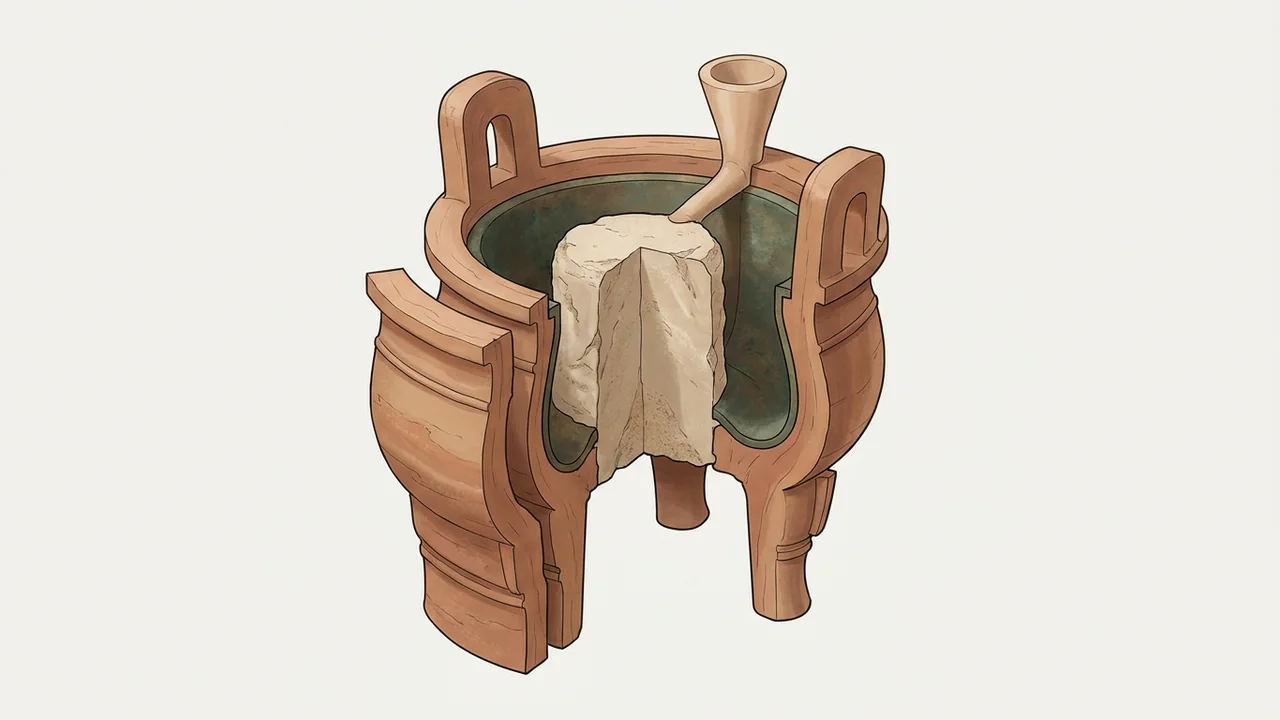
For a hollow vessel, the casting system has three important spatial parts: the outer mold that defines the exterior, the inner core that defines the interior, and the gap between them that becomes the bronze wall. The model, mold sections and core therefore work together as a planned system.
Piece mold casting is also written as piece-mold casting and, in British spelling, piece mould casting. These variants describe the same broad topic and are useful when researching museum, university and conservation resources.
How does piece mold casting work?
1. Forming the clay model
The process begins with a model of the intended vessel or object. The model establishes the exterior proportions, openings, relief and surface design that the mold will reproduce. Decoration can be shaped on the model or introduced through the mold design, depending on the object and the interpretation of the evidence.
The model is not the final bronze. It is the preparation form used to create the negative space into which the metal will flow. Any planning for handles, projecting parts or complex openings affects how the mold must be divided.
2. Creating the outer mold sections
An additional clay layer is formed around the model. Once the material has hardened, it can be carefully divided into sections that fit together around the intended object. The sections must be removable from the model and stable enough to be reassembled before casting.
The exact number and arrangement of pieces should not be presented as a fixed rule for every vessel. A simple form and a vessel with projecting handles, deep relief or unusual openings may require different mold planning. The important principle is the fitted, sectional outer mold.
3. Shaping and positioning the inner core
Many bronze vessels are hollow. In these cases, the original model can be reduced or otherwise prepared to serve as the inner core, or a core can be made as a separate part of the casting system. The core occupies the interior space that should remain empty after the bronze solidifies.
Core position matters because the distance between the core and outer mold determines the approximate wall space. The core also needs to remain stable while the mold is handled and filled. This is why the inside of a vessel is part of the casting design even when it is hidden from view.
4. Reassembling the mold and planning the pour
After the model is removed or prepared as the core, the outer mold sections are fitted back around it. The assembled mold must hold the desired shape while molten bronze enters the cavity. Openings, channels and supports may be arranged according to the form and casting conditions.
Ancient casting evidence can be complex. A visible opening, join or attachment does not automatically reveal the whole process, and a modern diagram should be understood as a simplified explanation. The safest public wording is to describe the general logic and separate it from object-specific archaeological proof.
5. Filling, cooling and opening the casting
Molten bronze fills the space between the outer mold and the inner core. After the metal solidifies, the clay mold sections are removed or broken away. Temporary casting features and residual mold material may need to be cleaned from the object.
The casting that leaves the mold is not automatically a finished display object. Edges, relief, openings and surfaces may require further work. Later finishing can alter the visibility of seams or other marks, so a photograph should not be treated as complete proof of the original casting sequence.
Why was piece mold casting important in ancient Chinese bronzes?
Piece mold casting helps explain how early Chinese bronze vessels could combine a controlled exterior form, raised decoration and a hollow interior. It shows that bronze production involved more than melting metal: model making, mold division, core placement, casting and finishing all influenced the result.
The technique is especially useful for understanding the relationship between surface design and mold construction. When a decoration is created in or transferred through a mold, the division of the mold becomes part of the design problem. This helps explain why early Chinese bronze studies often discuss vessel form, relief and mold technology together.
Historical casting should still be described with care. Different objects may have required different solutions, and the presence of piece-mold casting in one period or group of objects does not prove that every later object used the same method.
Piece mold casting and Shang dynasty bronze vessels
Searches for Shang dynasty bronze casting often lead to discussions of ritual vessels, mold technology and the organization of early bronze production. In that setting, piece mold casting is a useful way to understand how complex bronze forms could be planned and reproduced.
This article is not a complete history of Shang ritual, chronology or vessel typology. It uses Shang and Zhou bronzes as historical context for a casting method. To understand a specific vessel, readers should also examine shape, function, decoration, archaeological context and museum documentation rather than infer all of those details from the casting method alone.
For a separate explanation of a named vessel form, read What Is a Jue Cup?. The Jue Cup article explains a vessel type; this page explains a casting approach.
Piece mold casting vs. lost-wax casting
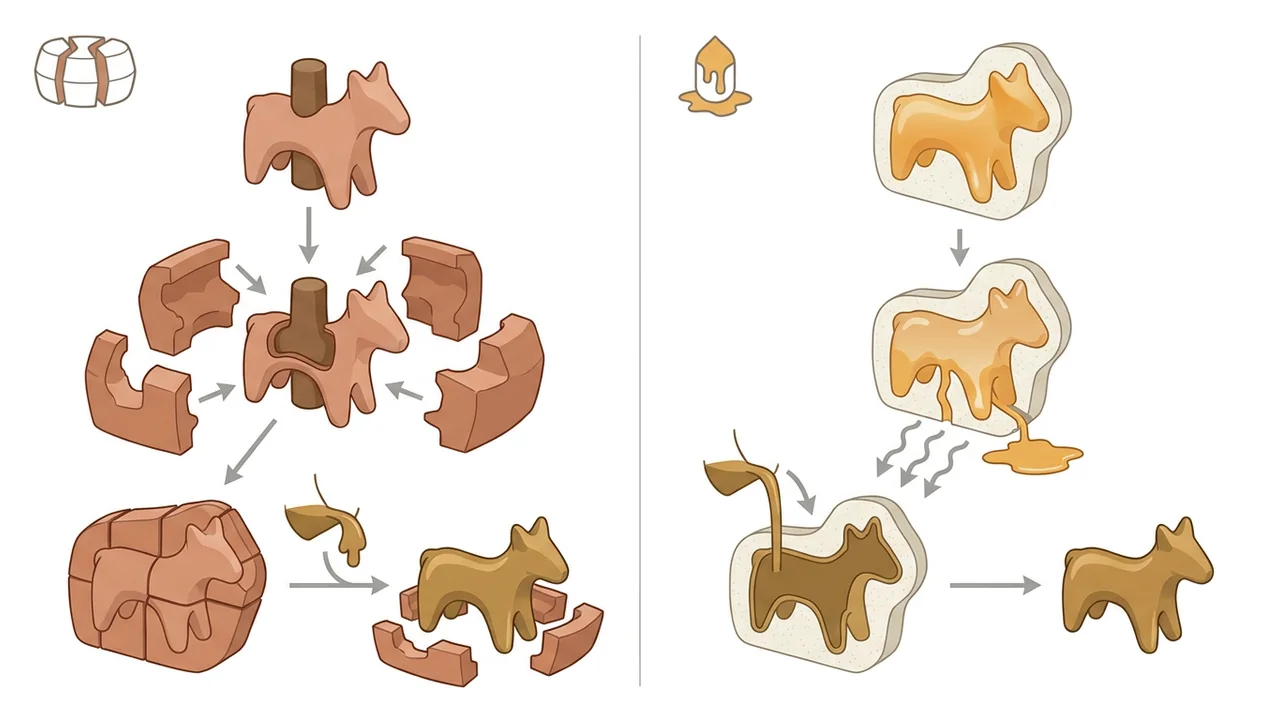
Piece mold casting and lost-wax casting use different model and mold strategies. In a general piece-mold explanation, fitted mold sections are assembled around a model and, for a hollow vessel, an inner core. In lost-wax casting, a temporary wax pattern is surrounded by an investment mold; the wax is removed to create a cavity that can receive molten metal.
| Question | Piece-mold casting | Lost-wax casting |
|---|---|---|
| Main mold logic | Fitted sections are assembled around the intended form and core. | A temporary wax pattern creates the cavity inside an investment mold. |
| Hollow interior | An inner core helps define the internal space. | The core and pattern arrangement depends on the object and process. |
| How the mold is opened | Sections are opened or broken away after the metal solidifies. | The investment mold is generally sacrificed after casting. |
| How to use the comparison | Useful for understanding early Chinese bronze-casting discussions. | Useful for understanding a general investment-casting sequence. |
The comparison is about process logic, not a ranking of quality. Neither method automatically guarantees historical accuracy, a particular surface finish or a better final object. The result also depends on the reference, model, material system, casting conditions and finishing.
For the general lost-wax sequence, read the lost-wax bronze casting process guide. The history of how and when lost-wax casting was used in ancient China remains a subject of scholarly discussion, so it is inaccurate to reduce the history to the statement that ancient China completely did not use lost-wax casting.
What do mold sections, cores and seams tell us?
Mold sections and cores help explain how a casting was organized. They can also help readers understand why a vessel may show joins, parting lines or areas that were later refined. These clues are valuable, but they have limits.
A photograph alone cannot prove the complete historical process, the identity of the workshop, the alloy, the date of an object or the cultural meaning of a surface mark. A visible line may relate to mold assembly, later finishing, repair or another stage of production.
This distinction matters when comparing a museum object with a modern reproduction. A modern object may reproduce a visible form and surface language while being made today with a different process. Similar appearance does not, by itself, prove identical production history.
Historical casting methods and modern bronze reproductions
A historical bronze and a modern bronze reproduction do not automatically share the same production method. A current object may use a process selected for its form, surface, intended use, available tools and project requirements.
CCLYF describes its products as modern Chinese bronze reproductions made today. For a buyer-focused explanation, see the modern reproduction clarity guide. Public content should not claim that every product uses piece-mold casting or lost-wax casting unless a product-specific source confirms that detail.
For buyers, the more useful question is not simply, "Which famous historical method does this object represent?" A better question is: Which production and finishing details can be confirmed for this specific object and current sample?
That distinction keeps cultural education separate from unsupported product claims. It also helps interior designers, cultural gift buyers and small-batch purchasers ask for information that can be checked before a quote or project decision.
What does this process guide tell a modern reproduction buyer?
Short answer: This page explains the general historical logic of piece-mold casting. It is not proof that a particular modern reproduction, current sample or CCLYF product was made with that method.
For a current object, separate the evidence into four levels. Photo evidence shows visible form, surface and photographed angles. Page evidence records the named object, public images and current inquiry path. Process evidence explains a general casting method and should not be read as a factory record. Quote-stage information includes material, confirmed dimensions, weight, packaging, commercial terms, project schedule and sample arrangements that must be checked for the specific project.
The CCLYF Buyer Evidence Center organizes these boundaries for buyers. The Bronze Casting Process guide explains general modern process stages, while Bronze Casting Defects and Buyer Checks helps identify questions about surfaces and finishing. For a vessel or artifact outside the listed collection, Custom Bronze Reproductions explains how to begin with photos, a model or other reference material.
Questions to ask when researching a modern bronze reproduction
Before requesting a quote, prepare questions that relate to the actual object:
| Question to confirm | Why it matters |
|---|---|
| What is the exact product or vessel form? | Similar vessel names can describe different proportions and details. |
| Which dimensions are confirmed for the current version? | A product image does not establish scale. |
| Is the process description general education or product-specific evidence? | A process article should not be mistaken for proof about one current product. |
| Which surface treatment is shown or requested? | A modern finish should be described as a current surface treatment. |
| Can the current sample or production photos be reviewed? | A concept visual is not evidence of a finished product. |
| What packaging and destination requirements need to be confirmed? | Export packing depends on the object and shipment. |
If a supplier cannot confirm a detail, record it as a point to verify rather than turning an assumption into a product claim. For broader sourcing preparation, read the Chinese bronze decor sourcing guide and the bronze incense burner wholesale guide.
Frequently asked questions
What is piece mold casting?
Piece mold casting is a method that uses fitted mold sections around a model and, for a hollow vessel, an inner core. Molten bronze fills the cavity between the outer mold and core. The mold is opened after the metal solidifies.
How is piece mold casting different from lost-wax casting?
Piece mold casting uses fitted sections and a core as part of the mold structure. Lost-wax casting uses a temporary wax pattern that is removed from an investment mold to create the cavity. The two methods should be compared by their mold and pattern logic, not treated as automatic quality rankings.
Why do some bronze vessels use an inner core?
An inner core helps define the internal cavity of a hollow vessel. The space between the core and outer mold becomes the area filled by the bronze.
Can a photograph prove the casting method?
No. A photograph may show a form, surface or possible join, but it cannot by itself prove the complete historical process, workshop, alloy, date or production method.
Does CCLYF claim that every product uses piece-mold casting?
No. This is a general history and process guide. Product-specific production details should be confirmed before they are stated as a CCLYF product fact.
Explore related bronze directions
Browse the Chinese bronze reproduction collection, the bronze incense burner series and the bronze Jue cup series.
Designers can review the interior designers buyer page, while small-batch purchasers can use the wholesale and small-batch buyer page. For a project-specific question, use Request a bronze reproduction quote.
Technical and museum sources
This article uses paraphrases and general explanations. The generated diagrams are educational illustrations, not evidence of a historical artifact, a real workshop or a CCLYF production method. For further reading, consult: