Quick answer: how does lost-wax bronze casting work?
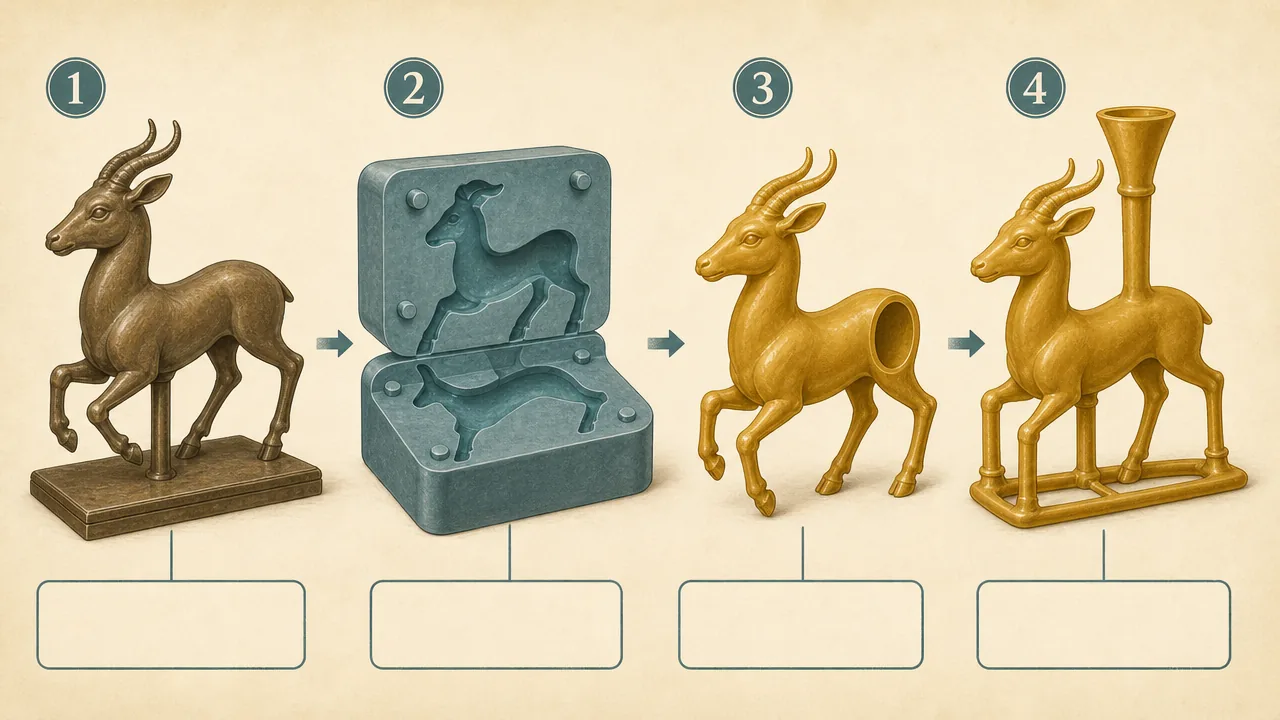
Lost-wax bronze casting is a process for creating a metal object from a temporary wax pattern. The wax pattern is surrounded by a refractory mold, heated so the wax can be removed, and then replaced by molten bronze. After the bronze cools, the mold is opened and the casting is cleaned, refined and finished.
The process is also commonly called investment casting. It is useful for complex forms because details created in the wax pattern can be transferred into the metal. However, not every bronze reproduction is made with lost-wax casting. The exact method depends on the object, the workshop, the material system and the required finish. For a comparison with fitted mold sections and inner cores, read the piece mold casting guide.
- Create a model and wax pattern.
- Attach a sprue and other casting channels.
- Build a refractory mold around the wax.
- Heat the mold to remove the wax and prepare the cavity.
- Pour molten bronze into the mold.
- Break away the mold after the metal solidifies.
- Cut, clean, chase, polish and finish the bronze surface.
What is lost-wax bronze casting?
In lost-wax bronze casting, the wax is a temporary model of the object. The pattern can be solid or can be formed around a core when the final object needs an internal cavity. A refractory investment is then built around the wax. When the assembly is heated, the wax is removed and leaves a cavity with the shape of the pattern. Molten bronze is poured into that cavity and allowed to solidify.
The mold is normally opened or broken after casting. This makes the process different from casting in a reusable metal mold. It can be labor-intensive, especially when the object has fine relief, openwork, undercuts or several connected parts.
Lost Wax Process of Bronze Casting: 7 Steps
1. Creating the model and wax pattern
The process begins with a model that defines the intended form. Depending on the project, the model may be made directly or reproduced from an existing reference model. A flexible working mold may then be used to form a wax pattern.
The wax pattern is important because details on the pattern can be transferred to the metal. Any seam, surface mark, opening or attachment that is part of the pattern may influence the final casting. Complex objects can be made in sections and joined with wax before the mold is built.
2. Adding the sprue and gating system
The wax pattern needs a planned path for molten metal. A sprue is the main entry channel. Gates and runners help guide the metal to different areas, while vents or risers may be used where the design and casting conditions require them.
This part of the process is not only a technical detail. Channel placement can affect how completely the mold fills and where later cutting or surface repair will be needed.
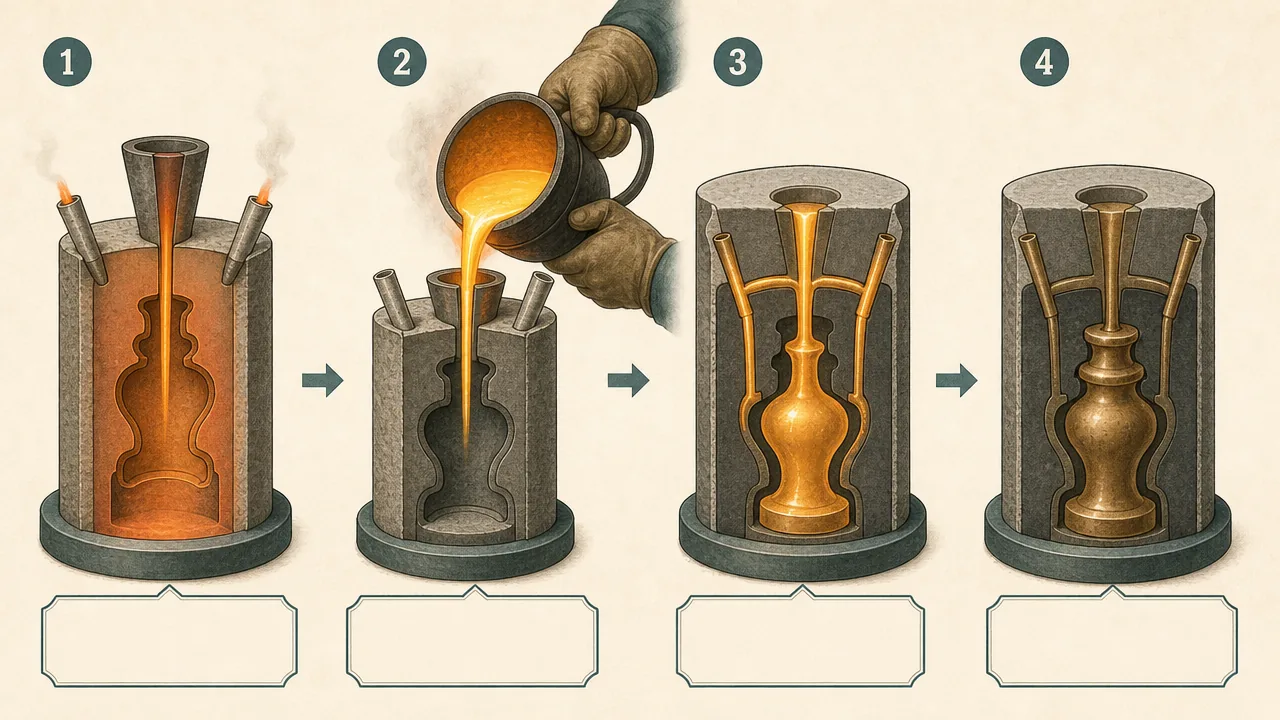
3. Building the refractory mold
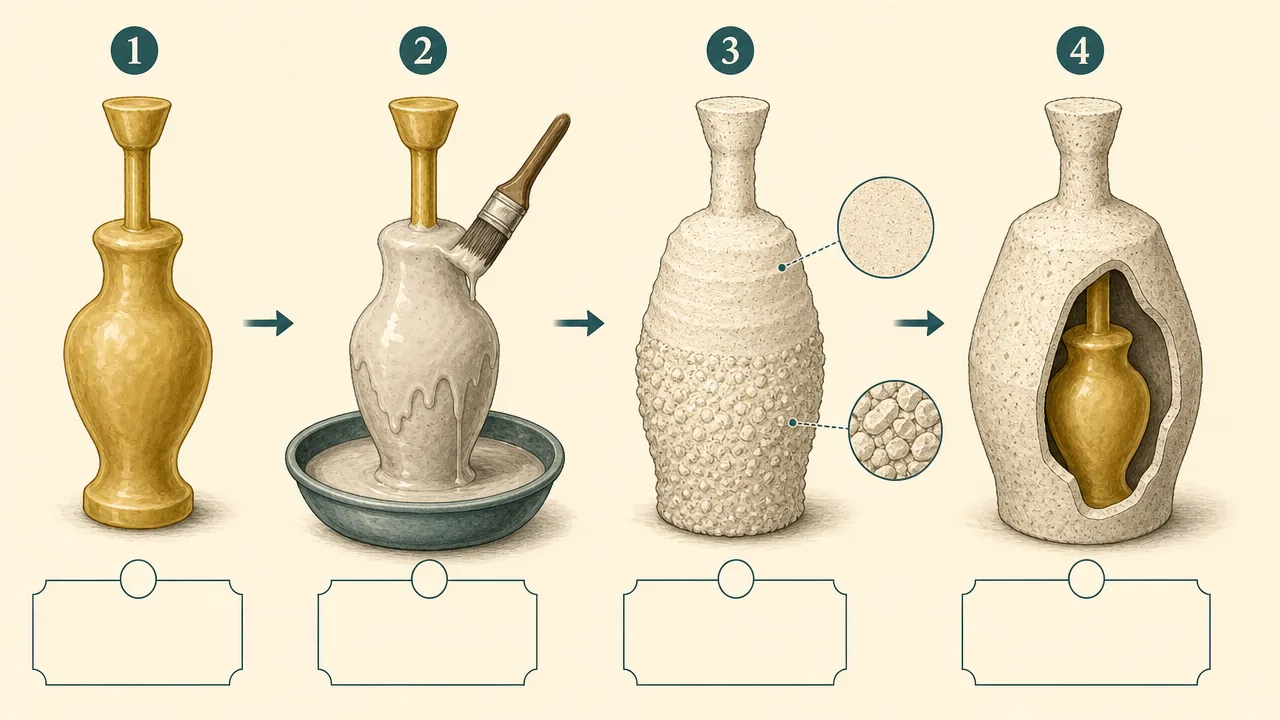
The wax pattern is covered with refractory material that can withstand heat and contact with molten metal. In modern investment casting, a ceramic or similar investment may be applied as a slurry in layers. Each layer must harden before the next layer is added.
When a layered ceramic shell is built around the wax pattern, the method is often described as ceramic shell bronze casting. That phrase describes the mold system, not a guaranteed alloy, finish or historical production method; the exact materials and layer schedule depend on the foundry and object.
The finished shell needs to be strong enough for handling and casting while still capturing important surface details. The exact material system can differ between foundries and projects, so a general article should not present one layer count, binder or shell recipe as a universal standard.
4. Wax removal and burnout
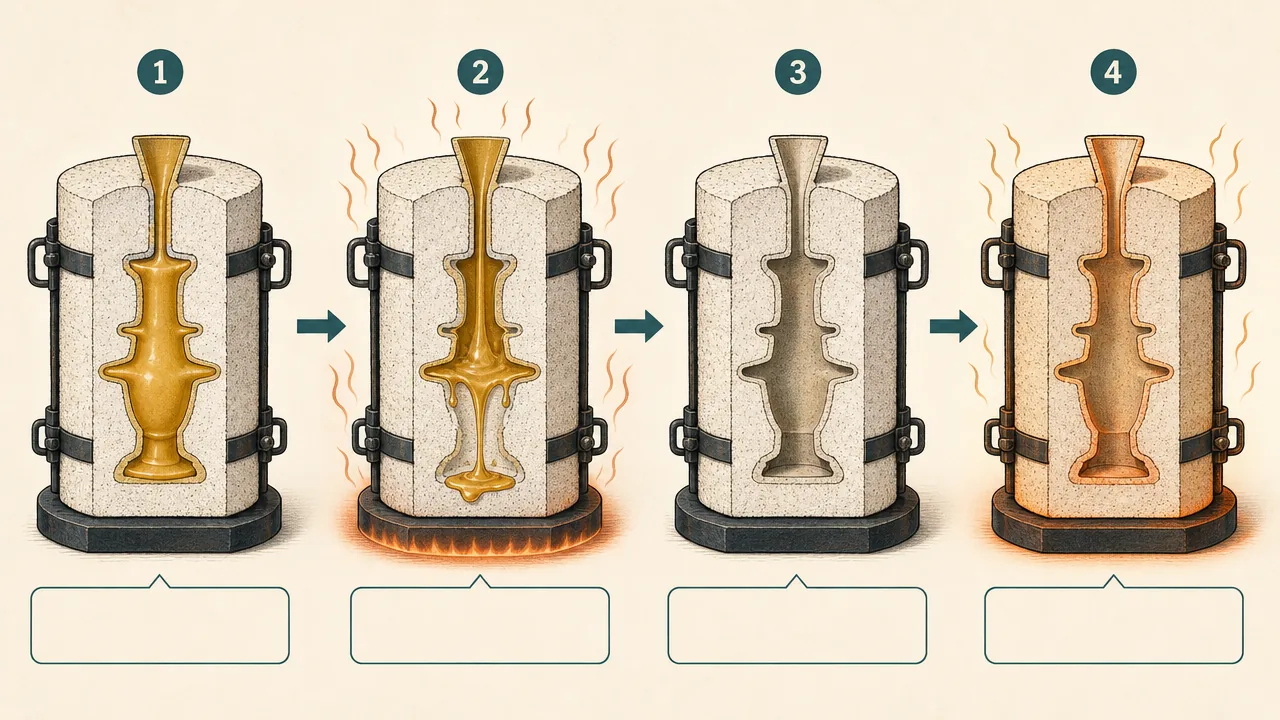
After the mold has dried, controlled heating removes the wax through the sprue and gating system. Heating may also continue to remove organic residue and prepare the refractory mold for metal. This is why the method is called lost-wax casting: the wax pattern is sacrificed to create the cavity.
It is more accurate to describe this as a controlled burnout process than as simply melting wax and pouring it away.
5. Pouring molten bronze
Once the mold is prepared, molten bronze is introduced through the sprue. The metal flows through the gating system and fills the cavity left by the wax pattern. The mold may be heated or otherwise prepared according to the casting method and the object design.
The result depends on more than the pouring step alone. Pattern quality, mold strength, channel design, metal condition, filling behavior, cooling and later finishing all influence the final casting. Public product content should not invent a fixed alloy recipe, pouring temperature, pressure or equipment specification without confirmation from the relevant workshop.
6. Removing the mold and refining the casting
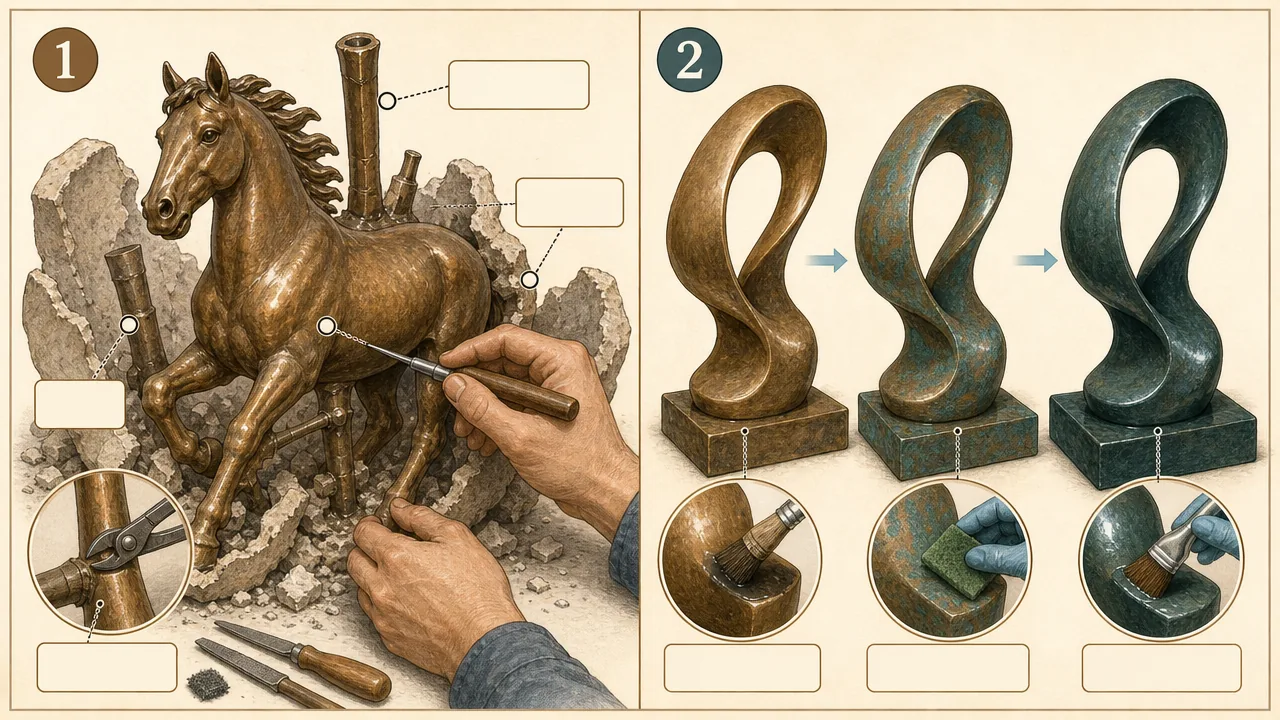
After the bronze has solidified, the hardened mold is broken away to release the casting. The sprue, gates, vents and other temporary structures are removed. Residual mold material and core material may also need to be cleaned from the object.
The casting is not automatically a finished product at this stage. Workers may grind, file, chase, weld, repair or polish selected areas. Fine surface work can restore edges, clarify relief and reduce visible traces left by the casting system.
7. Patina and surface finishing
Surface finishing gives the bronze its final visual character. Depending on the project, finishing may include polishing, controlled coloration, patina work, waxing or another protective treatment.
For modern bronze reproductions, it is safer to describe this as surface coloration, patina finishing or an aged bronze finish. These terms make clear that the object is a modern reproduction with a selected surface treatment, not a historical original or an authenticated historical object.
Why use lost-wax casting for complex bronze forms?
Lost-wax casting can be useful when a form includes details that would be difficult to remove from a rigid mold. A wax pattern can also be shaped, joined and refined before the refractory mold is built. This gives the maker control over relief, openings, curves and other features.
The process also has limitations. The mold is generally sacrificed after casting, the work can require substantial manual labor, and the final result still depends on cleaning and finishing. Lost-wax casting should therefore be understood as one production method, not as an automatic guarantee of quality or historical accuracy.
Lost-wax casting and modern bronze reproductions
Some bronze reproduction workshops in the Luoyang area publicly describe lost-wax-related processes for selected reproduction work. That regional information should be stated carefully. It does not prove that every bronze reproduction made in Luoyang uses lost-wax casting, and it does not prove the process used for a particular brand or product.
The safest buyer question is not simply, "Is this lost wax?" A better question is: Which casting and finishing process is used for this specific object, and which details can be confirmed from the current sample?
For a modern reproduction, buyers may also want to confirm the visible form, approximate dimensions, surface treatment, packaging requirements, destination and whether the sample represents the production version. These checks are more useful than treating one process name as a guarantee.
Are all Chinese bronze vessels made with lost-wax casting?
No. Chinese bronze vessels and modern bronze reproductions can involve more than one casting tradition. A historical form, a museum photograph or a similar-looking product does not by itself prove which process was used.
This distinction is important when discussing named vessel types. A modern reproduction may use a production method selected for its shape and intended finish, while the historical object that inspired it may have been made with a different casting tradition. The terms modern reproduction, replica and reproduction bronze should remain visible when the page is discussing current products.
Buyer checklist for a bronze reproduction
Before requesting a quote, ask for information that can be checked against the actual product:
| Check | Why it matters |
|---|---|
| Exact product name or reference image | Similar vessel forms can have different proportions and details. |
| Confirmed dimensions and approximate weight | A product image does not establish scale. |
| Casting method for the selected object | The process may vary by form and workshop. |
| Surface and patina description | A finish should be described as a modern surface treatment. |
| Packaging and destination requirements | Export packing depends on the object and shipment. |
| Sample or current production photos | A concept visual is not evidence of a finished product. |
| Quantity and intended use | Hospitality, interior design, display and gift projects may need different checks. |
If a supplier cannot confirm a detail, record it as a point to verify rather than turning an assumption into a product claim.
Frequently asked questions
Is lost-wax casting the same as investment casting?
The terms are commonly used for closely related processes in which a temporary wax or similar pattern is surrounded by an investment mold, removed through heating and replaced by molten metal. Exact materials and steps can vary by foundry.
Why is wax used in bronze casting?
Wax is useful because it can be shaped into a detailed temporary pattern. When the pattern is removed, it leaves a cavity that can be filled with metal.
Does lost-wax casting make every reproduction historically accurate?
No. Casting method, shape reference, surface finish, dimensions and historical documentation are separate questions. A modern reproduction should be described honestly as a modern reproduction.
Does CCLYF claim that every product uses lost-wax casting?
The public information currently available does not establish that every CCLYF product uses this process. Product-specific production details should be confirmed before they are stated as a brand or product fact.
Explore related bronze reproduction directions
For product browsing, see the Chinese bronze reproduction collection, the bronze incense burner series and the bronze Jue cup series.
For context and buyer preparation, read the Chinese bronze decor sourcing guide, the bronze incense burner wholesale guide, the piece mold casting guide and the page explaining modern reproductions and historical originals. For a project-specific recommendation, use the interior designers buyer page, the wholesale and small-batch buyer page or Request a Quote.
Technical and museum sources
This article explains the general process and does not present generated illustrations as workshop evidence. For further reading, consult:
- The Metropolitan Museum of Art: wax models, cores, sprues, gates, burnout and finishing
- The Metropolitan Museum of Art: ancient openwork bronze casting
- Stanford Product Realization Lab: investment casting
- Getty Conservation Institute: technical examination of bronze sculpture
- Palace Museum: lost-wax casting reference
Regional Luoyang examples should be cited separately and described as reports about selected local workshops, not as proof of a universal industry process or a CCLYF-specific production method.