Quick answer: how were Shang and Zhou bronze vessels different?
For the differences between Shang and Zhou bronze vessels, the safest answer is continuity plus change. They share many forms and technical traditions, so the difference is not a simple change from one style to another. Early Zhou makers and users inherited important Shang vessel shapes, decorative vocabulary and casting knowledge, then reorganized them within a different political and ritual order.
In broad terms, late Shang bronzes are often recognized in historical discussions for powerful vessel bodies, dense animal-mask and animal-form decoration, and a strong association with ritual wine and food ceremonies. Zhou bronzes continue some of these traditions, but Western Zhou vessel sets, inscriptions and decorative choices increasingly communicate lineage, rank, appointment, authority and remembered events. By the Eastern Zhou period, regional variation becomes especially important.
The safest summary is therefore continuity plus change: Shang Dynasty bronze vessels provide an important foundation, while Zhou Dynasty bronze vessels adapt that foundation across new ritual combinations, inscription practices, regional styles and visual preferences.
Shang vs Zhou bronze vessels at a glance
The table is a study guide, not a dating formula. Period, region, vessel type and object history all matter.
| Comparison point | Shang bronze vessels | Zhou bronze vessels |
|---|---|---|
| Historical position | Late Shang forms are a major reference point for early Chinese ritual bronzes and later reinterpretations. | Early Western Zhou inherits and reorganizes Shang traditions; Western and Eastern Zhou later develop different regional directions. |
| Ritual sets | Wine vessels are prominent in many discussions of late Shang ritual assemblages, alongside food and water-related forms. | Wine vessels remain important in early Western Zhou, while food-vessel groupings become more prominent in later Western Zhou discussions. |
| Decoration | Dense animal-mask, animal-form and geometric patterns are common subjects in discussions of late Shang decoration. | Earlier motifs continue, while phoenix-like birds, scrolling forms, geometric bands and more open compositions become important in different contexts. |
| Inscriptions | Inscriptions occur on Shang bronzes, but their meaning and historical value must be read object by object. | Many well-known Zhou inscriptions record appointments, gifts, events, lineage and authority, making context especially important to interpretation. |
| How to identify | Use body shape, supports, handles, posts, spouts, decoration and documented context together. | Use the same visible clues, while also considering Western Zhou or Eastern Zhou setting and regional variation. |
This comparison helps explain why the phrase Shang and Zhou bronze ware covers both shared traditions and meaningful changes. It should not be used to force every vessel into one fixed period style.
A short timeline: late Shang to Eastern Zhou
A useful history of Shang and Zhou bronze vessels begins with a sequence rather than a binary comparison.
- Late Shang: Ritual bronzes form a highly developed visual and technical tradition. Vessel bodies, legs, handles, spouts, posts and surface decoration work together as a complete object language.
- Early Western Zhou: Zhou elites inherit established Shang forms and casting traditions. Some early Zhou objects can look strongly Shang-influenced, which is why a single motif or silhouette is not enough to establish date.
- Middle and later Western Zhou: Vessel combinations and ritual priorities change. Food vessels become more prominent in many discussions, and longer inscriptions help preserve information about appointments, gifts, lineage and events.
- Eastern Zhou: Regional courts and states contribute to a more varied bronze landscape. Local styles, new combinations and continued engagement with earlier forms make the phrase Zhou bronze vessels too broad to describe one uniform appearance.
The Metropolitan Museum of Art overview of the Shang and Zhou dynasties is a useful starting point for the wider political and cultural timeline. For an object-level conclusion, consult the record for the specific vessel rather than relying on a general period label.
Ritual sets and the changing role of vessel forms
One of the most useful ways to compare Shang Dynasty ritual bronzes with Zhou Dynasty ritual bronzes is to look at groups of vessels, not only individual shapes. A Jue, Gu, Zun, Ding or Gui has its own visible vocabulary, but the combination of forms can also show how a ritual setting was organized.
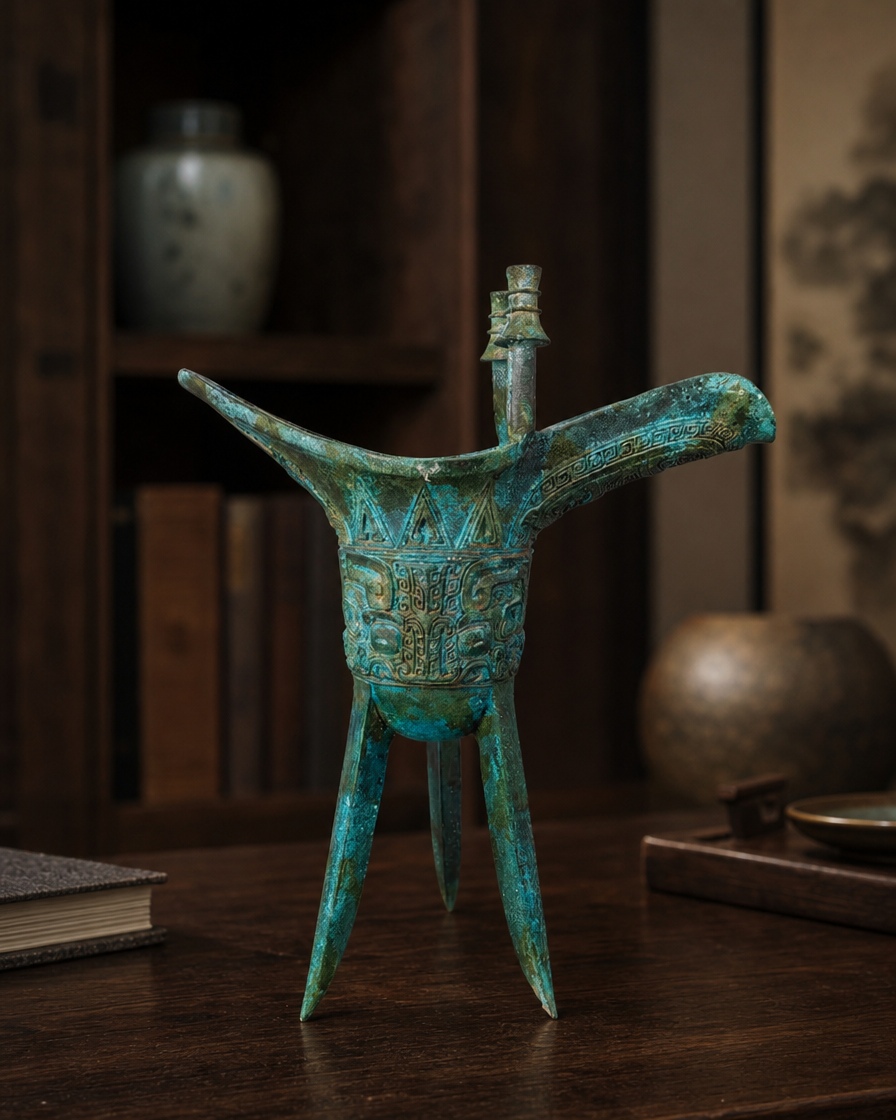
Late Shang discussions often give considerable attention to wine vessels such as Jue, Gu and Zun. These forms can be compared through legs, spouts, posts, tall bodies, openings and handles. That does not mean every Shang ceremony used the same set or that every vessel had one fixed role.
During the Western Zhou, the relationship between wine vessels and food vessels changes in many historical accounts. Ding and Gui become especially important reference forms when discussing food-vessel groupings and the ritual order associated with Zhou political authority. The change is gradual and contextual, not a complete replacement on one exact date.
For readers learning the vocabulary, the Chinese Bronze Vessels guide gives a broader form overview, while What Is a Jue Cup? focuses on the three legs, projecting spout, raised posts and other visible Jue features.
Decoration: Taotie, animals, birds and geometric patterns
Decoration is one of the most visible differences discussed when comparing Shang and Zhou bronze vessels, but it is also one of the easiest areas to oversimplify. Late Shang surfaces are often described through dense relief, animal masks, animal components and geometric borders. The visual effect can be compact, powerful and highly integrated with the vessel body.
Zhou decoration does not simply abandon earlier motifs. Instead, earlier visual language continues alongside new preferences and reorganization. Bird and phoenix-like forms, scrolling lines, wave-like or geometric bands, and more open arrangements become important subjects in different Western Zhou and Eastern Zhou contexts.
It is safer to describe a change in visual language than to claim that one motif belongs exclusively to one dynasty. The Taotie motif guide explains why a face-like pattern can be described visually without assigning every example one fixed creature, meaning or date.
A motif can support comparison, but it cannot by itself prove that a vessel is Shang, Zhou, old, excavated or historically original. Body construction, inscription, context, provenance and the documented object record all matter.
Inscriptions: why context matters
Inscriptions are another important part of the comparison. A short mark, clan sign or inscription can be highly meaningful, but readers should resist treating every visible character as a simple label for dynasty, owner or use.
Many well-known Western Zhou inscriptions are discussed in relation to appointments, gifts, commands, land, military events, lineage and ritual memory. This makes the inscription part of a historical record as well as a surface feature. The meaning still depends on the exact text, object, date, archaeological context and scholarly reading.
Shang inscriptions also require object-specific interpretation. It is not accurate to reduce them to one universal function, just as it is not accurate to read a modern decorative mark as a historical inscription without evidence.
For a buyer or general reader, the practical rule is simple: record what is visibly present, then separate it from what a catalogue or specialist source confirms. A modern reproduction may borrow a vessel shape or decorative language without reproducing a documented inscription or making a historical-origin claim.

Why early Zhou bronzes can still look Shang-influenced
The transition from Shang to Zhou was not a clean visual reset. Early Zhou rulers and elites inherited objects, craft knowledge, ritual practices and established forms. Early Zhou bronzes can therefore retain Shang-influenced silhouettes or decoration while participating in a new political and ceremonial order.
This continuity explains why a visual comparison needs a timeline and an object record. If a vessel has a familiar animal mask, three legs or tall wine-vessel body, those details help describe the form, but they do not settle the date. An early Zhou vessel may intentionally preserve an earlier language, and a later work may deliberately revive an earlier style.
The same principle applies to modern reproductions. A made-today object can be inspired by a Shang or Zhou form without sharing the original object's age, provenance, casting history or ritual setting.
Historical bronzes versus modern Chinese bronze reproductions
Historical comparison is useful for vocabulary and visual orientation. It should not be used to turn a current product photograph into evidence of a historical object.
CCLYF presents modern Chinese bronze reproductions made today. A current product page can show visible features such as a body, legs, posts, spout, lid, handles, surface direction or motif reference. It does not automatically establish Shang or Zhou date, excavation, provenance, museum certification or original ritual use.
When a buyer wants a Shang-inspired or Zhou-inspired direction, the practical brief should state:
- Which form is being discussed: Jue, Gu, Zun, Ding, Gui or another vessel direction.
- Which visible features matter most: body proportion, legs, spout, posts, handles, lid or decoration.
- Whether the request is for a listed sample or a custom object from photos or drawings.
- The required quantity, destination, intended setting and packaging questions.
- Which details still need quote-stage confirmation, including material, dimensions, weight, price, MOQ and delivery timing.
The general Bronze Casting Process guide explains a modern reproduction workflow in broad terms. It should not be read as a fixed production specification for every product. For a reference-led project, see Custom Bronze Reproductions.
How to compare Shang and Zhou bronze vessels responsibly
Use the following sequence when reading a museum image, a research page or a modern product reference:
- Describe the visible silhouette before assigning a period.
- Identify the vessel features: body, opening, supports, legs, handles, posts, spout, lid and foot.
- Separate decoration from the vessel category. A Taotie-like motif does not define the entire object.
- Check whether the source discusses late Shang, early Western Zhou, middle Western Zhou, Eastern Zhou or another context.
- Read inscriptions through the named object record, not from a cropped photograph alone.
- For a modern reproduction, confirm current product evidence and quote-stage details separately from historical background.
This method is useful for students, designers, collectors and buyers because it preserves both the visual richness of Shang and Zhou bronze ware and the uncertainty that responsible object identification requires.
Frequently asked questions
What is the main difference between Shang and Zhou bronze vessels?
The main difference is a broad shift in ritual organization, inscription practice and visual language within a strong continuity of forms and casting traditions. It is not one single shape change that applies to every vessel.
Were Shang bronze vessels mainly wine vessels?
Wine vessels are prominent in many discussions of late Shang ritual bronzes, but Shang assemblages included more than one vessel family. The exact role depends on the period, object and context.
Did Zhou bronze vessels stop using Taotie motifs?
No. Earlier decorative vocabulary could continue, change or be reorganized. A motif should be compared with the complete object and its context rather than treated as an exclusive dynasty marker.
Can decoration prove that a bronze vessel is Shang or Zhou?
No. Decoration can provide a comparison clue, but it does not by itself prove date, authenticity, provenance or original use.
Can CCLYF discuss a Shang-inspired or Zhou-inspired reproduction?
Yes. Buyers can start with a listed form, reference photograph, drawing or project brief. Specific feasibility, sample options, material, dimensions and quote details are confirmed case by case.
Sources and further reading
These sources provide broader period, vessel and casting context. Their statements apply to the named historical records or teaching pages, not automatically to current CCLYF products.
- The Metropolitan Museum of Art: Shang and Zhou DynastiesGeneral period context for the political and cultural transition.
- The Metropolitan Museum of Art: Wine container (hu)Object-level reference for reading vessel terminology and collection context.
- Smithsonian National Museum of Asian Art: Piece-mold casting glossaryTechnical context for an important bronze-casting tradition associated with ancient Chinese bronzes.
- Asian Art Museum: Casting Bronze Vessels - The Piece-Mold ProcessEducational explanation of mold sections, cores and casting sequence.
- Chinese Bronze Vessels: Types, Forms and Ritual ContextBroader vessel-form vocabulary and modern reproduction boundaries.