Quick answer: what are Chinese bronze vessels?
Chinese bronze vessels are a broad family of historically important forms associated with ritual, ceremonial, food-serving, wine-related and other display contexts. The word vessel describes a group of forms rather than one single object. A ding may be recognized through a tripod or square-sided structure, while a jue, zun, gu or gui has a different silhouette and vocabulary.
For modern interiors and cultural sourcing, the most important distinction is simple: a historical Chinese bronze vessel and a made-today modern Chinese bronze reproduction are not the same thing. A reproduction can be inspired by an established form, but its age, provenance and production details must be described separately and confirmed at the product level.
People searching for ancient Chinese bronze vessels may mean excavated or museum-held historical objects, later archaistic works or modern reproductions inspired by earlier forms. This guide uses the historical terms for orientation, while keeping age, provenance and product status separate.
History of Chinese bronze vessels: a concise evolution
The history of Chinese bronze vessels is best understood as a long development of forms, uses and visual languages rather than a single straight line. Across different periods and regions, makers and users adapted vessel bodies, legs, handles, lids, spouts, posts, feet, inscriptions and surface decoration for changing ritual and ceremonial contexts.
- Early named forms: Forms such as jue, ding, gui and related vessels became recognizable through recurring silhouettes and combinations of supports, openings and handles. Their historical meaning still depends on the individual object and its documented context.
- Changing proportions and decoration: Chinese bronze vessel evolution can be seen in variations of body shape, scale, relief, geometric bands and inscriptions. A motif or silhouette can help with comparison, but it is not by itself a date or authenticity test.
- Later reinterpretation: Earlier vessel forms were collected, studied, revived and adapted in later periods. An archaistic work or modern reproduction may refer to an older form without sharing the original object's age, provenance or production history.
This high-level Chinese bronze history is useful for vocabulary and visual orientation. For a specific object, compare the visible form with a reliable museum or academic record. For a made-today product, confirm the exact page, photographs and quote-stage details instead of inferring historical identity from appearance alone.
For a broader historical reference, see the Metropolitan Museum of Art overview of the Shang and Zhou dynasties. For practical form comparison, continue to the Chinese bronze vessel types table.
Chinese bronze vessel types at a glance
The table below is a practical starting point for comparing common Chinese bronze vessel forms. Historical use and meaning varied by period, region and object, so these descriptions are orientation notes rather than a complete classification system.
| Vessel form | Visible clues | Historical context | Modern display direction |
|---|---|---|---|
| Ding | Round tripod or square-sided body, legs and sometimes handles | Often discussed in ritual food and ceremonial contexts | A strong focal form for a study, entrance or collection display |
| Jue | Three legs, projecting spout and raised posts | Often discussed as an early ritual wine-vessel form | A compact cultural object or gift direction |
| Zun | Substantial body with a broad or flared opening in many examples | Frequently discussed in ritual wine-vessel contexts | A larger statement silhouette where space allows |
| Gu | Tall, slender profile with an expanded opening | Frequently discussed in ritual wine-vessel contexts | A vertical display form for a shelf or console |
| Gui | Rounded body, often with handles | Often discussed as a ritual food-container form | A rounded counterpoint to taller vessel forms |
| Hu | Covered container form; proportions vary | Context varies by object, period and source | A covered form for comparative display |
| Dou | Elevated bowl-like form on a stem or foot | Identification should be checked against the specific object record | A distinctive profile for a curated grouping |
The safest way to compare a vessel is to begin with visible form: body shape, legs, handles, lid, spout, posts, foot and overall proportion. Historical interpretation should then be checked against a reliable museum or academic source.
For a focused explanation of the Zun term and its variants, read What Is a Chinese Bronze Zun?. That guide keeps Zun terminology and modern reproduction questions together without treating every vessel as one fixed historical type.
How to identify Chinese bronze vessels
For practical Chinese bronze vessel identification, start with the silhouette before interpreting decoration. A useful first pass is to record the body, opening, support, handles, lid, spout, posts and proportions, then compare those clues with a museum or academic object record.
- Describe the body as round, square, tall, covered, stemmed or footed.
- Count and describe the legs, feet or supports.
- Note handles, raised posts, a projecting spout, a lid or a separate cover.
- Separate visible form from assumptions about date, ritual use, authenticity or provenance.
- Use the confirmed object record or product description before assigning a narrow name.
Chinese bronze vessel names and meanings
Names such as ding, jue, zun, gu, gui, hu and dou are useful labels for comparing established vessel forms. Their meanings are not interchangeable, and the same English description can hide important differences in body shape, support and historical context. In a buyer conversation, the form name is a starting point for selecting a sample, not proof of age or a complete historical classification.
When a request is based on a photograph, use both the visible description and the proposed form name. That makes it easier to confirm whether the need is a known vessel type, an adapted decorative object or a custom Chinese bronze vessel direction.
Ding vessels: tripod and square forms
The ding is one of the most recognizable Chinese bronze vessel forms. It is often introduced through a round tripod structure, while square-sided examples are also part of the wider ding vocabulary. The exact period, construction and use should be checked against the individual museum or academic record rather than inferred from the word alone.
When comparing a bronze ding vessel, start with practical visual questions:
- Does the body rest on three legs or form a square-sided structure?
- Are handles, a cover or prominent surface decoration visible?
- Is the object a historical vessel, a later archaistic work or a modern reproduction?
- Are dimensions and visible details confirmed for the specific object?
The phrase bronze tripod vessel can be a useful visual description, but it should not automatically be treated as one fixed historical category. Shape, period and documented context all matter.
Jue cups and early bronze wine vessels
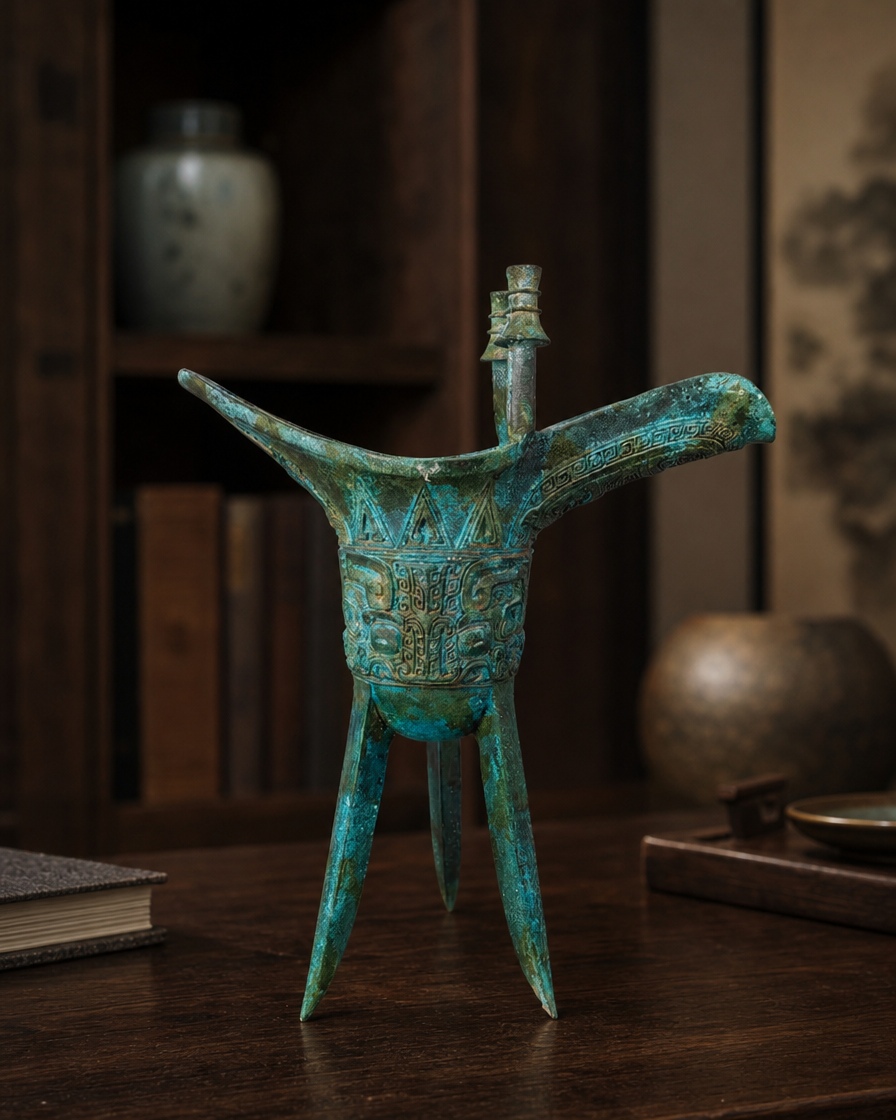
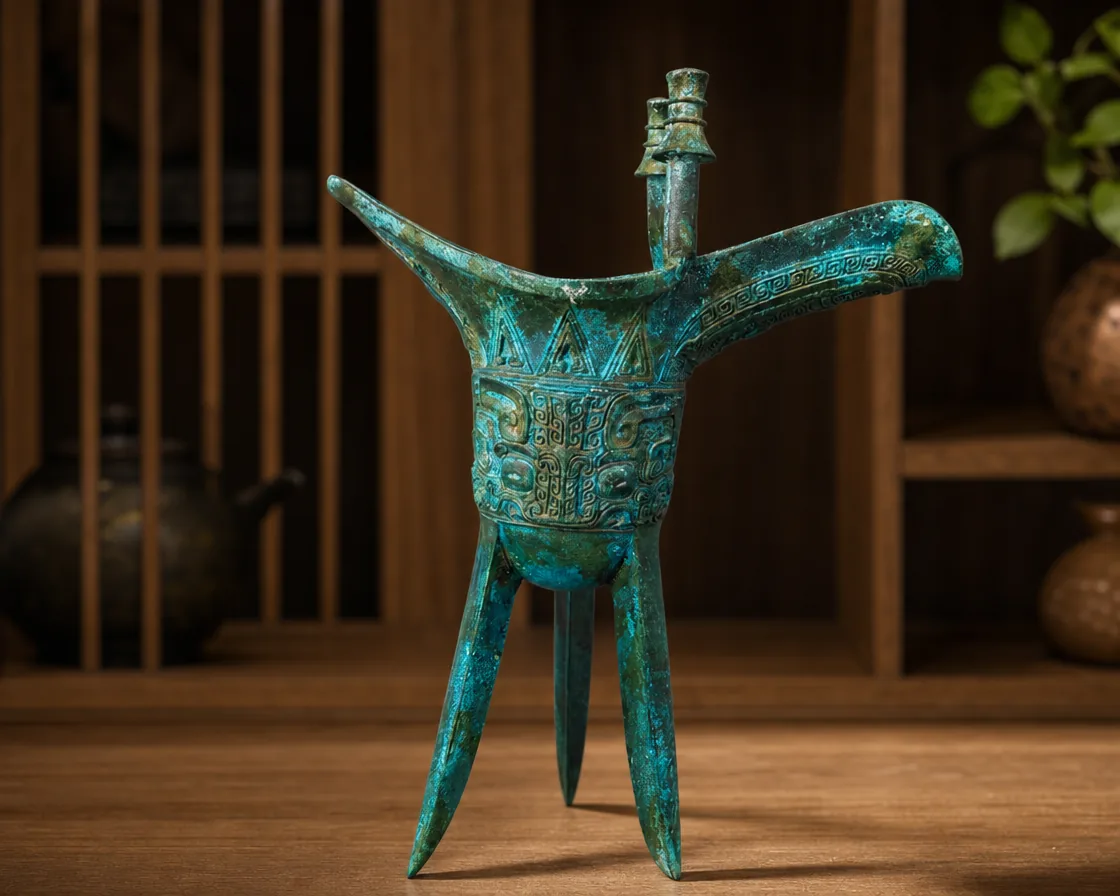
A jue is commonly recognized through three legs, a projecting spout and raised posts. It is often discussed as a ritual wine-vessel form in early Chinese bronze contexts. Broader searches for ancient Chinese wine vessels often include this kind of early ritual form, while the more specific phrase Chinese bronze wine vessels helps distinguish the vessel vocabulary from modern generic cups. The exact date, context and interpretation still depend on the object record.
The Jue form shows why precise vessel terminology is useful. Two objects may both be called bronze cups in casual English, but a more specific form name can communicate the silhouette, historical reference and display direction more clearly.
For a fuller explanation of the Jue silhouette, read What Is a Jue Cup?. For modern product browsing, visit the Bronze Jue Cups series.
Zun and Gu vessels
Zun and gu are often discussed together because both belong to the vocabulary of Chinese bronze wine vessels, yet their proportions are different. The difference between zun and gu is easiest to explain through silhouette: a gu is commonly associated with a tall, slender profile, while a zun is often more substantial in volume and visual weight. The exact appearance varies across periods and individual objects.
For modern display planning, the distinction can be expressed in practical terms:
- A gu tends to create a vertical line and may suit a shelf, console or narrow display zone.
- A zun can provide more visual mass and may work as a statement object where there is enough surrounding space.
- A grouping of both forms can create contrast through height, width and surface rhythm.
These are display observations, not guarantees about historical use or meaning. A specific object should always be described from its own documented form and source context.
Gui, Hu, Dou and related forms
Chinese bronze vessel terminology includes many forms beyond the most familiar ding, jue, zun and gu. Gui is commonly represented as a rounded ritual food container, while hu and dou cover other directions with different bodies, lids, handles, stems or feet.
For a general reader, a useful comparison method is to ask:
- Is the body open, covered, rounded, tall or square?
- Does the vessel stand on legs, a foot or a stem?
- Are handles, posts, a spout or a lid part of the main silhouette?
- Is the term being used for a historical object, a later revival or a modern reproduction?
This approach is more reliable than assigning a vessel to a category from one decorative motif alone.
Ritual context and visual language
Chinese ritual bronze vessels are often discussed through several connected layers: physical form, ceremonial context, decoration, inscription, period and archaeological or collection history. A vessel name can offer a useful starting point, but it does not replace object-specific research.
Decorative features may include animal masks, geometric bands, handles, feet, posts, inscriptions or raised relief. These details can help readers compare visual language, but they should not be turned into unsupported claims about a product's age, authenticity or exact historical function.
The same caution applies to the word artifact. In a historical museum context, Chinese bronze artifacts may refer to documented objects in a collection. On a modern product page, safer language is modern Chinese bronze reproduction, inspired by Chinese bronze vessel forms or made today for contemporary display.
Historical forms versus modern bronze reproductions
Historical Chinese bronze vessels and modern reproductions can share a form reference without sharing the same age, provenance or production history.
At CCLYF, the website's product language stays clear: products are modern Chinese bronze reproductions made today for contemporary display, gifting and sourcing conversations. A product photograph can show the visible object presented on the page, but it does not prove that the object is ancient, excavated, museum-certified or historically original.
Before requesting details, compare:
- The exact product name and product page.
- The visible form: body, lid, feet, posts, handles and surface direction.
- Confirmed dimensions for the selected piece.
- The intended setting, quantity and destination.
- Whether the request concerns a single sample, a small-batch project or a broader sourcing discussion.
For more detail on this boundary, read the Modern Reproduction Clarity guide.
How buyers can use Chinese bronze vessel terminology
Vessel terminology gives a buyer and sourcing team a shared starting point. Instead of writing only Chinese bronze decor, a buyer can describe a direction such as:
- A compact Jue-inspired form for a cultural gift.
- A tripod ding-inspired silhouette for a study or entrance display.
- A tall gu or substantial zun direction for a hospitality setting.
- A lidded incense burner form for a tea or incense space.
- A mixed vessel group for an interior design project.
Terminology does not replace sample confirmation. It helps narrow the conversation so that the selected product, dimensions, surface direction, packaging requirements and destination details can be checked before a quote.
Chinese bronze vessels for interior design are usually evaluated through scale, visual weight, placement, surface direction and the surrounding material palette. If the request is for a modern Chinese bronze vessel reproduction beyond the listed collection, the Custom Bronze Reproductions page explains how to start with a reference image, form direction or project brief.
Explore the Bronze Incense Burners series, browse the bronze decor collection, or review wholesale and small-batch sourcing before sending a request for a quote.
Frequently asked questions
Difference between ding and jue: what should buyers look for?
A ding is generally recognized as a tripod cauldron or related tripod vessel form, while a jue is a smaller wine-vessel form with a spout, posts and three legs. The exact historical context depends on the period and object.
Are Chinese bronze vessels always ancient objects?
No. The phrase can describe historical museum objects, later works inspired by earlier forms or modern reproductions. Product pages should state clearly which category applies to the object being offered.
Difference between zun and gu: how do the forms compare?
Zun and gu are names used for different Chinese bronze vessel forms often discussed in ritual wine-vessel contexts. Their proportions and details vary, so a specific museum record or product description should be checked rather than relying on a label alone.
How to identify Chinese bronze vessels?
Begin with the body, opening, support, handles, lid, spout, posts and proportions. Then compare those visible clues with a reliable object record or the confirmed product description. Decoration alone is not enough to establish a vessel name, date or provenance.
How should buyers describe a modern bronze reproduction?
Use the confirmed product name or page, describe the visible form, include the required dimensions and quantity, and explain the intended setting or gift project. Avoid presenting a modern reproduction as an old or authenticated object.
Further reading and source notes
This article uses cautious paraphrases and general explanations. The CCLYF product images are modern reproduction references, not historical artifact evidence or proof of a specific production method.