
What is a Chinese bronze Zun?
A Chinese bronze Zun is a type of ancient Chinese vessel associated with wine and ritual contexts. Museum records show that Zun examples often have a broad, flared mouth and a raised foot, but the category includes more than one form. The safest way to understand a Zun vessel is to study specific dated examples rather than assume that every Zun has one identical silhouette.
The word can appear in English catalogues as Zun vessel, wine vessel (Zun) or ritual wine container (zun). These phrases point to a related group of Chinese vessel forms, but catalogue wording may vary between institutions and periods. For a broader map of ding, jue, zun, gu, gui, hu and dou, see the guide to Chinese bronze vessel forms.
What does the word Zun refer to?
In the context of Chinese bronze studies, Zun is commonly used for a vessel associated with wine and ritual use. The Metropolitan Museum of Art record for Wine vessel (Zun) describes a bronze ritual wine vessel and notes a wide, flared lip, a feature that helps readers understand the form of that particular object.
The British Museum record for a Chinese bronze Zun uses similar terminology and describes a vessel with a widely flared lip and a tall footring. These descriptions are useful starting points, but they should be read as object-specific catalogue evidence. A museum label for one Zun does not automatically describe every vessel called Zun.
How to recognize a Zun vessel
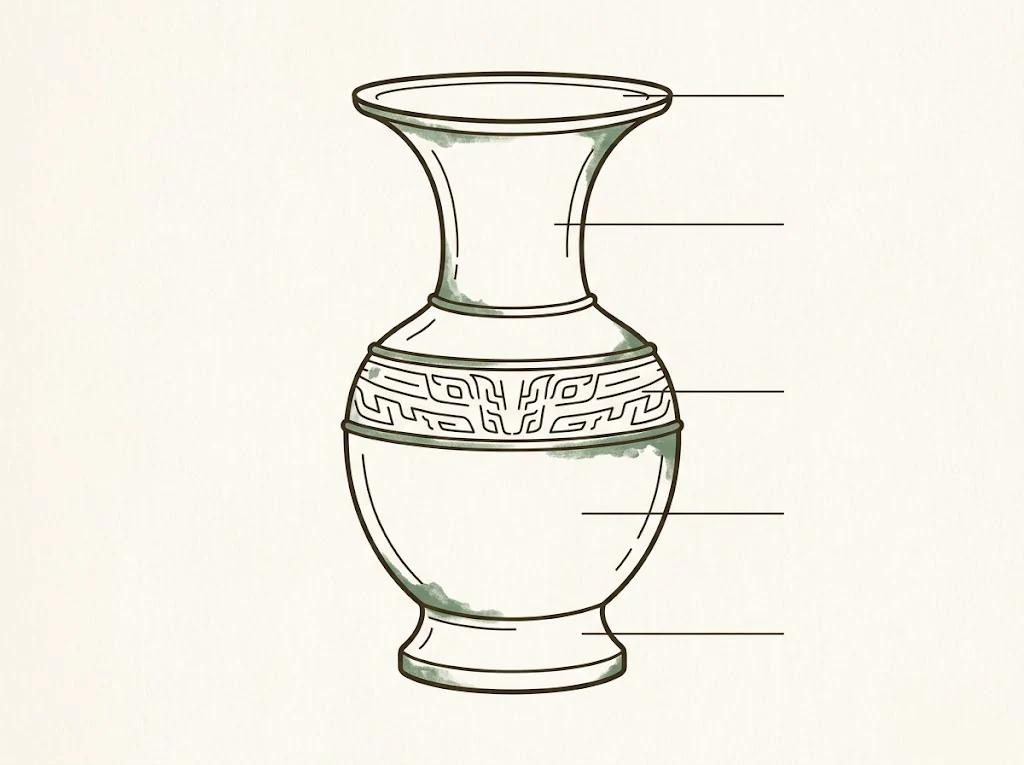
The diagram above is a simplified educational illustration. It shows a common vessel profile for discussion, not a reconstruction of one named historical object. The five labels correspond to the following visible areas:
- Flared lip: the broad upper rim visible in many catalogue examples.
- Neck: the narrower section below the lip in this simplified profile.
- Decorative band: a zone that may carry relief or geometric ornament in a particular example.
- Body: the main container area.
- Foot: the raised lower support, which may appear as a footring or a more developed base.
These features help a reader describe what is visible. They do not prove the object's date, provenance, alloy, casting method or authenticity. A photograph can support a visual description, but historical identification requires a source record and, where relevant, specialist examination.
Zun as a Chinese ritual wine vessel
The phrase Chinese ritual wine vessel is useful because it captures both the object category and the context in which many bronze vessels are discussed. Ancient Chinese bronze vessels were not simply interchangeable containers. Their forms, inscriptions, decoration and recorded contexts can carry different historical meanings.
At the same time, readers should avoid making an absolute claim about every Zun. The safest wording is that museum records associate specific Zun examples with wine and ritual contexts. The exact period, form, decoration and historical interpretation should be attached to the cited example being discussed.
This distinction matters for modern buyers. A modern bronze reproduction may borrow the visual language of a historical vessel while remaining a contemporary decorative object. Its appearance alone does not establish that it is a historical original, a museum-certified object or a reproduction of one specific museum piece.
Zun vs. Jue: What Is the Difference?
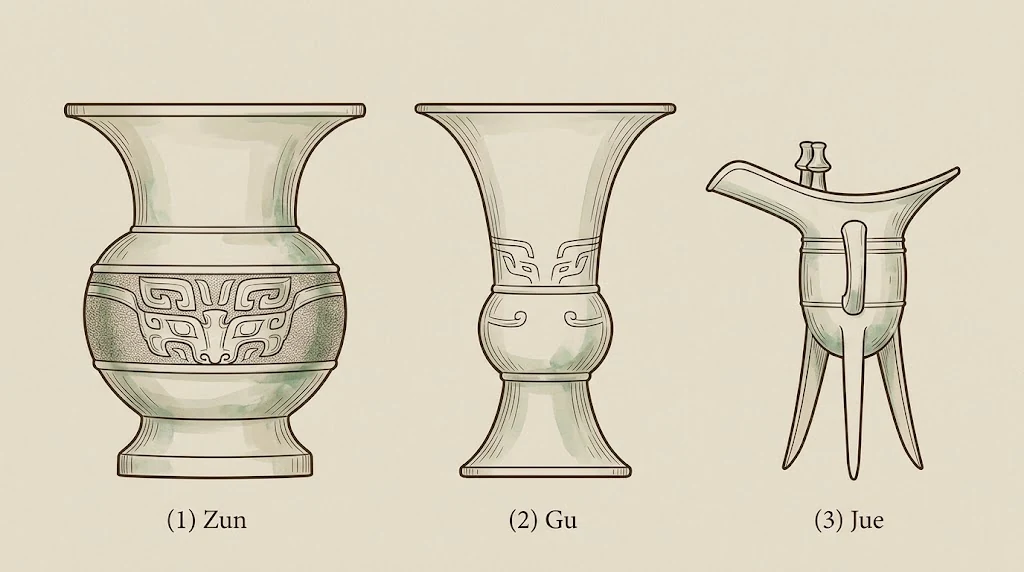
Zun, Gu and Jue are often discussed together because they belong to the vocabulary of ancient Chinese bronze vessels and wine-related ritual objects. They are separate vessel terms and should not be treated as interchangeable names.
In a quick visual comparison, a common Zun profile is a broader wine container with a flared mouth and raised foot, while a Jue is a three-legged ritual wine vessel with a forward spout, tail and upright posts. These are useful high-level clues, not universal rules for every dated object.
The Metropolitan Museum's record for a Western Zhou ritual altar set uses separate catalogue terms for a ritual wine container (zun), a ritual wine vessel (jue) and a ritual wine beaker (gu). This provides a useful high-level comparison, while the exact form and use of individual objects still require object-specific sources.
| Vessel term | Safe high-level description | What to avoid assuming |
|---|---|---|
| Zun | A wine vessel or ritual wine container in cited museum records, often discussed through a broad body, flared mouth and raised foot in common profiles. | That every Zun has one fixed body, period or animal form. |
| Gu | A wine beaker in the cited catalogue terminology. | That one simplified silhouette represents every Gu. |
| Jue | A three-legged ritual wine vessel with a spout, tail and upright posts in the focused comparison. | That every Jue has identical proportions or that Jue and Zun are different names for the same object. |
For a more focused explanation of the Jue form, read what a Jue cup is. The two guides serve different responsibilities: this article explains Zun terminology, while the Jue page focuses on the tripod, spout, tail, posts and handle of a Jue cup.
Different Zun forms in museum collections
One reason the keyword zun vessel can be confusing is that the word does not point to one modern product shape. Museum collections contain Zun records with different dates, proportions, decorations and forms. Some records describe conventional vessel bodies with a broad mouth and raised base. Other museum records use Zun terminology for animal-shaped vessels, including object records held by the Brooklyn Museum and Harvard Art Museums.
When discussing an animal-shaped example, name the institution and object record instead of presenting a general rule that all animal-shaped bronze vessels are Zun. This source-first approach also helps separate three different things:
- a historical object documented by a museum;
- a modern object inspired by a Chinese bronze vessel form; and
- a product whose exact historical reference has not been confirmed.
The terms may look similar in a search result, but they should not be treated as equivalent in a product description.
Chinese bronze Zun and modern reproductions
Modern Chinese bronze reproductions can be made for display, interiors, cultural gifts, hospitality settings and sourcing projects. The correct description depends on the confirmed product facts and the reference used for the selected sample.
For buyers, the key distinction is simple: a made-today modern reproduction is not a historical original, a museum-certified object or proof of a particular ancient casting process. A concept visual can help a buyer discuss form, but it is not evidence of final material, dimensions, weight, packaging, inventory or production details.
For the wider boundary between historical terminology and current products, read modern bronze reproduction guidance. For current modern animal-form directions, see the animal-form bronze vessel reproductions collection. That collection is a modern product destination and should not be read as a claim that every product shown there is a historical Zun.
Questions to ask before ordering a modern bronze reproduction
Before requesting a quote, a buyer can make the conversation more precise by sharing:
- The vessel direction or reference form being considered.
- The intended use, such as interior display, cultural gifting or hospitality design.
- The preferred quantity range and destination.
- The sample details that need confirmation, including dimensions, material, finish and packaging.
- Whether the request concerns a general form direction or a specific historical reference.
These questions keep the inquiry practical without turning an unverified historical association into a product claim. The cultural gifts buyer guide and hotels and tea spaces buyer guide can help frame intended use before you use the Request Quote path for the current confirmation process.
Frequently asked questions
What is a Zun vessel?
A Zun is a type of ancient Chinese vessel associated with wine and ritual contexts. Museum records show multiple Zun forms, so the term should be understood through specific examples rather than one universal silhouette.
Is every Zun a bronze wine vessel?
The phrase bronze Zun refers to bronze examples, and many museum records discuss Zun in wine and ritual contexts. Each example should still be identified by its material, date and object record instead of applying one description to every use of the term.
What is the difference between a Zun and a Jue?
They are separate vessel terms. A cited museum catalogue can describe a Zun as a ritual wine container and a Jue as a ritual wine vessel, while the visible shapes and historical contexts differ by object and period.
Does a Zun always have the same shape?
No. Museum records show variation in proportions, decoration, dates and forms. A generic diagram is useful for learning vocabulary, but it is not a complete catalogue of every Zun.
Is a modern Zun-style reproduction a historical original?
No. A made-today modern reproduction should be described as a contemporary reproduction or form reference unless separate evidence supports a different claim. A similar silhouette does not establish age, authenticity or museum provenance.
Sources and further reading
Source note: This guide uses named museum collection records for historical terminology and keeps those object-specific descriptions separate from claims about CCLYF products.
- The Metropolitan Museum of Art: Wine vessel (Zun)Object record for a bronze ritual wine vessel.
- The British Museum: Chinese bronze ZunObject record describing a vessel with a flared lip and raised footring.
- The Metropolitan Museum of Art: Western Zhou ritual altar setCatalogue record that lists Zun, Gu and Jue terms separately.
- The Metropolitan Museum of Art: Chinese bronze vessel recordAdditional dated collection context.
- The Metropolitan Museum of Art: Chinese bronze vessel recordAdditional object-specific form and period context.
- Brooklyn Museum: animal-shaped bronze vessel recordNamed example for discussing animal-shaped forms carefully.
- Harvard Art Museums: Chinese bronze vessel recordNamed collection record for object-specific comparison.