
Learn / Chinese bronze censer guide

What Is a Chinese Bronze Censer?

Compare open, lidded, tripod, Boshan and sculptural-support form directions, then use modern reproduction and quote-stage checks to choose a current display reference.

Source note: Historical and technical context is presented as general reference information, with source links used where a specific object or process is discussed. Current product details should be confirmed from the selected sample and quote.

Modern reproductions made today - not historical originals

Educational illustration comparing open, lidded, tripod and mountain-lid Chinese bronze censer form directions
Illustration: four form directions for comparison; conceptual education visual, not a historical artifact or product photograph.

What Is a Chinese Bronze Censer?

A Chinese bronze censer is a bronze vessel-form object associated with holding, burning or presenting incense. In shorter search language, a Chinese censer is an incense-related vessel whose shape can be open, covered, tripod-based or supported by a figure. For readers asking what is an incense burner?, a censer is one vessel-based form associated with incense-related display or use. Its design may include an open bowl, a covered body, a pierced lid, short feet, a tripod base, handles or a sculptural support. The word censer emphasizes the vessel's relationship to incense. Incense burner is the more familiar everyday phrase for this broad category.

The exact form matters. A low open vessel has a different visual presence from a tall lidded burner. A tripod censer creates a different balance from a piece supported by an animal, phoenix or human figure. A mountain-lid direction adds vertical movement above the vessel body. These distinctions help with comparison. They do not establish a complete historical classification, fixed date, original use or manufacturing method.

For current display and sourcing, begin with the bronze incense burner reproductions series. The series page compares current product directions; this guide explains the vocabulary behind those directions.

Censer, incense burner or incense holder?

These phrases overlap, but they do not always carry the same emphasis. The phrase Chinese bronze incense burner is common in product and buyer searches, while censer often appears in specialist or museum writing. The table below helps readers understand the wording without treating one label as a complete historical category.

PhraseWhat it helps the reader understandPractical note
CenserA vessel-form object associated with incenseUseful in museum, historical and specialist writing.
Incense burnerA broader everyday description of an object used around incenseCommon in product, interior and buyer searches.
Incense holderA holder or support for incense or an incense-related objectCan refer to simpler accessories, not only bronze vessel forms.

When a buyer reviews a modern reproduction, the most useful questions are more specific than the category name: Is the body open or covered? Does it have three feet? Is the lid mountain-shaped? Is there a figure or animal support? What are the confirmed dimensions and finish direction?

Types of Chinese Incense Burners: Bronze Form Directions

Open or low-profile vessel forms

An open or low-profile incense burner is read through its rim, body, base and overall silhouette. Without a tall lid, the form can feel quieter and more architectural. Compare the body width, rim height, base shape and the amount of open space above the vessel. Do not assume that an open silhouette proves a particular period or original use.

Lidded and covered incense burners

A lidded incense burner adds a second visual layer: the vessel body below and the lid above. For a current product reference, see the Bronze Incense Burner with Lid. Confirm the current sample photos, overall height, body width, lid profile, surface direction and packaging scope before ordering.

Tripod censers and tripod incense burners

A tripod censer is identified by its three-foot base. Compare the angle and spacing of the feet, clearance beneath the body, shelf footprint and relationship between the body and lid. A visible three-foot structure is a useful form description, but it does not by itself prove one lineage, date or ritual meaning.

Boshan burner or mountain-lid forms

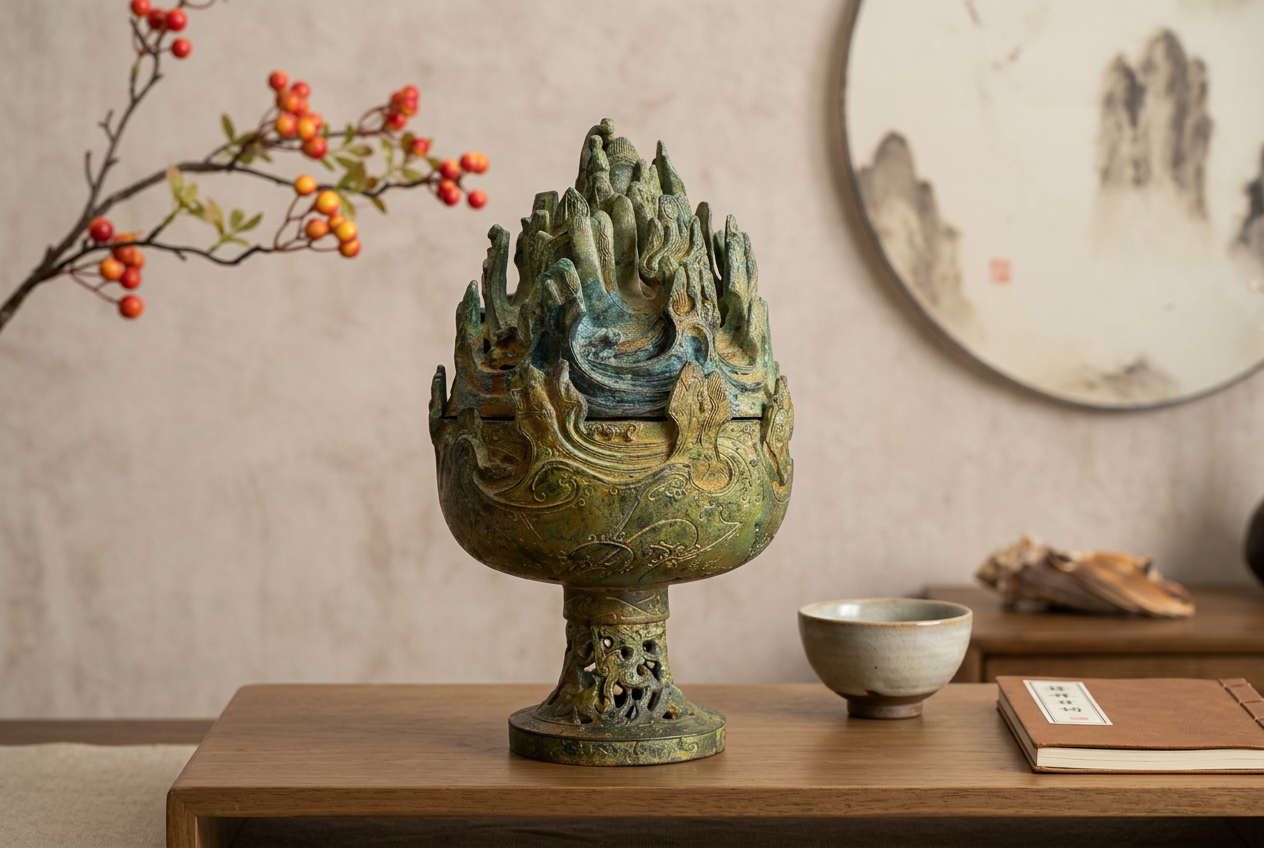
The phrase Boshan incense burner usually points readers toward a burner with a mountain-shaped or hill-shaped lid direction. Check the lid-to-body join and how much of the body remains visible. Also check whether the object has feet or a support figure. Then compare its complete height from the front and side. For one object-specific reference, see the British Museum mountain-shaped incense burner record; it should be read as an example, not as proof about every current reproduction. The figure-supported mountain-lid Boshan incense burner is a modern reproduction made today, not a historical original or proof of age, provenance or a particular ancient production method.

Sculptural and animal-shaped forms

Some incense burners use an animal, bird, phoenix or human figure as part of the support or body design. Figure supports change the object from a simple vessel silhouette into a figurative display piece. A documented historical example should remain tied to its named source; it should not be used to imply that every sculptural burner has the same meaning, use or construction.

Form directionWhat a buyer can compareSafe interpretation
Open or low-profileRim, body, base, width and visual opennessA silhouette direction, not a fixed period or use.
Lidded or coveredLid profile, openings, body, feet and total heightConfirm the current sample rather than generalizing from the label.
TripodThree feet, lower clearance, footprint and balanceA visible structural direction; lineage varies by object.
Boshan or mountain-lidPeak-shaped lid, openings, height and body-to-lid ratioA mountain-shaped form reference; object-specific context still matters.
Figure-supported or sculpturalSupport figure, body position, lid and visual focusA modern display direction unless a named historical object is being discussed.

Boshan incense burners and mountain symbolism

The mountain-shaped lid is the defining visual clue behind many searches for a Boshan censer, Boshan burner or Boshan incense burner. From a buyer's perspective, start with the visible form. Look for peaks or layered contours above the vessel, openings or negative spaces in the lid, and the way the lid sits on the body.

Historical interpretations of mountain-shaped burners can be meaningful, but they must be attributed to the relevant source and object. A museum record may discuss a particular object's date, material, collection history or symbolic reading. Those details should not be transferred to a modern reproduction that uses a similar form name. For current interiors, the mountain-lid direction can work as a strong focal shape in a study, tea space, hospitality shelf or cultural display.

Sources for object-specific historical context

Official collection records can help readers compare named objects and terminology. These records describe specific museum holdings; they are not evidence about CCLYF products, age, provenance or authentication.

Modern reproductions, not historical originals

CCLYF presents modern Chinese bronze reproductions made today, inspired by Chinese bronze vessel forms. This wording tells the reader that a present-day product can draw on a recognizable vessel direction without adding unverified age, provenance, museum or authentication claims.

Surface language also needs care. A dark bronze tone, green-blue effect, aged-style finish or highlighted motif describes a visible design direction. It does not prove historical age or provenance. Likewise, a product photograph can help a buyer review shape and surface, but it cannot prove age, origin or a specific casting method. For more context, read the modern reproduction clarity guide.

How to compare a modern bronze censer for display

A modern bronze censer should be compared as both a visual object and a sourcing decision. Use these questions before selecting a direction:

  1. Where will it be displayed? A study shelf, tea table, hotel lounge, reception area and cultural gift presentation each have different scale and visibility needs.
  2. Which form direction fits the room? An open body may feel quiet; a tripod may feel grounded; a mountain-lid or sculptural support may become the main focal point.
  3. What must fit the space? Confirm overall height, body width, lid height, base footprint and clearance around supports.
  4. What evidence is available? Ask for current sample photos, visible views, confirmed dimensions and a clear finish description.
  5. What needs to be confirmed before ordering? Clarify the selected form, quantity range, destination, packing questions and any gift presentation discussion.

For broader sourcing context, read the bronze incense burner wholesale guide and the small-batch bronze sourcing page. For hospitality projects, see bronze objects for hotels and tea spaces. These pages address the transition from learning about a form to preparing a practical inquiry.

What to confirm before requesting a quote

Before requesting a quote, send the model direction, quantity, destination country, intended use and timeline. If the order is for gifts, say whether gift presentation should be discussed. If the order is for interiors or hospitality, describe the room type and approximate display context. This helps CCLYF understand whether the inquiry is a single object, small-batch sourcing, a mixed product group or a custom bronze reproduction inquiry.

For the product itself, use this checklist: Sample photos available before order, Size confirmed before quote, Material confirmed before order and Packaging confirmed before quote. Ask to confirm the lid, body, feet, handles, support figures, surface tone, finish direction and any visible motif zones. If shipping is important, also review Packing & Shipping before the quote conversation.

Related CCLYF incense burner products and pages

Start with the bronze incense burner reproductions series and the Bronze Incense Burner with Lid. For sourcing boundaries, read modern reproduction clarity, the CCLYF reproduction policy or Custom bronze reproductions.

General buyer questions are covered in the Chinese Bronze Reproduction FAQ. When the model direction and quantity are clear, go to Request Quote and include destination, timeline, display use and packaging needs.

FAQ

Incense burner buyer questions.

What is a Chinese bronze censer?

It is a bronze vessel form associated with incense display and fragrance use, often recognized by a vessel body, lid, feet, handles or sculptural supports in different designs.

Are CCLYF incense burners historical originals?

No. CCLYF presents modern reproductions made today. They are not historical originals and not museum-provenanced objects.

What is a Boshan incense burner direction?

Boshan commonly describes a mountain-style lid direction. Buyers should confirm the exact lid, body, support and sample photos before quote.

Can an incense burner reproduction be used as a gift?

Yes. A bronze incense burner gift can be discussed for cultural gifts, interiors or hospitality sourcing, with packaging confirmed before quote.

What details should buyers check?

Check lid, body, feet, handles, support figures, surface tone, finish direction, sample photos, size, material and packaging before order.

Can I request custom size or finish?

Yes. Custom size, finish and packaging can be discussed through a custom bronze reproduction inquiry, then confirmed before quote or order as appropriate.

Request Quote CTA

Ask about an incense burner model,
gift option or custom direction.

Send product direction, quantity, destination, timeline and packaging needs. CCLYF will confirm sample photos, size, material and packaging before order.

Request Quote Email info@cclyf.love ->
Request incense quote