
Quick answer: what are Chinese bronze bells?
Chinese bronze bells are cast metal instruments and ritual objects with a long history in China. They can be discussed as individual bells, as groups of suspended chime bells, or as part of a larger ceremonial and musical setting. The safest first description is visual: note the bell body, mouth, suspension feature, decorative bands, bosses, inscriptions and supporting frame before assigning a narrow date or meaning.
The term Chinese bronze bells covers more than one shape and period. Some bells are relatively plain, while others carry complex relief, animal or geometric decoration. Some were designed to be struck from a particular direction, and some historical sets were arranged so that different bells produced different pitches.
For CCLYF, this is a knowledge and reference topic connected to custom discussion, not a claim that every bell shown in a workshop showroom is a current catalog item. A buyer can use a bell photograph, drawing or physical reference to begin a conversation, while exact feasibility, material, dimensions, weight, sound behavior, finish, packaging and delivery details remain quote-stage questions.
Bianzhong history: what is bianzhong?
Bianzhong is the Chinese term commonly used for a set or arrangement of bronze bells suspended in a frame. In English, it is often translated as bronze chime bells, Chinese chime bells or simply a bell chime. The word refers to an organized group rather than only one bell, although a single bell may be discussed as part of a bianzhong tradition.
A bianzhong display is normally read through three connected elements: the individual bell forms, the order and spacing of the set, and the frame or supports that hold the bells. The frame is therefore not just a background. It helps communicate how the bells are arranged, approached and viewed as an ensemble.
One famous historical example is the large bell ensemble excavated from the tomb of Marquis Yi of Zeng. It is frequently used in museum and educational discussions because it demonstrates the scale, organization and musical ambition associated with ancient Chinese chime bells. A historical example like this should be studied through its own archaeological and museum record; it should not be used to label an unrelated modern display as the same object.
How did ancient Chinese bronze bells make different notes?
The short answer is that bell shape, size, wall profile and striking position can affect the sound. In a historical chime-bell set, the bells were not treated as identical copies. Their dimensions and forms were organized so that the ensemble could produce a range of tones when struck in the intended way.
Some Chinese bronze bells are described as having two usable striking areas that can produce different pitches. This is why a responsible explanation should distinguish the general acoustic principle from the exact performance behavior of one named historical set. A photograph can show the mouth, bosses and outer form, but it cannot by itself confirm tuning, pitch, alloy, wall thickness or sound quality.
| Visible or documented factor | What it may help explain | What still needs confirmation |
|---|---|---|
| Bell size and body proportion | Why a set may contain different visual scales and sound ranges. | Exact pitch, tuning system and performance result. |
| Mouth and cross-section | How the bell body is shaped and how the opening is presented. | Acoustic behavior of a particular bell. |
| Bosses or raised studs | Visible decoration and possible striking-area context in some forms. | The intended striking method for an unrecorded object. |
| Frame and suspension | How a group is arranged as a bianzhong-style ensemble. | Load, stability, installation and safe handling requirements. |
This distinction is useful for buyers too. A modern bronze bell can reproduce a historical visual direction without automatically reproducing a documented ancient tuning system or performance specification.
Chinese bronze bells in Shang and Zhou history
Bronze bells belong to the wider history of Chinese ritual bronzes, but their role should not be reduced to one dynasty or one fixed meaning. Shang and Zhou bronze traditions overlap, and early Zhou objects can continue forms, techniques and decorative language associated with late Shang practice. The historical transition is better understood as continuity plus reorganization.
In a broad comparison, late Shang bronze culture is often discussed through highly developed ritual vessels, dense surface decoration and ceremonial use of bronze objects. Zhou history adds important evidence about changing political authority, lineage, ritual order and inscriptions. Bells and other instruments need to be read within that wider context rather than separated from the ritual and social systems around them.
The Shang vs Zhou Bronze Vessels guide gives a broader comparison of form, ritual sets, decoration and inscriptions. It is a useful companion because it explains why a visible motif or silhouette should not be treated as a complete dating formula.
For a general period overview, see the Metropolitan Museum of Art overview of the Shang and Zhou dynasties. The overview provides historical context, while a named bell or bianzhong must still be checked against its specific museum, excavation or research record.
Chinese chime bell forms: what can you see?
When looking at a Chinese bronze bell, begin with the visible structure rather than the assumed period. A useful description can include the following parts:
- Body: The main cast bell wall, which may be rounded, elongated, flattened or shaped with distinct zones.
- Mouth: The lower opening and its outline, including whether the lower edge appears straight, curved or more complex.
- Suspension feature: A loop, handle, fitting or upper support used to hang the bell or connect it to a frame.
- Bosses and relief: Raised studs, bands, masks, animals, geometric units or other surface features visible on the exterior.
- Inscriptions: Characters or marks that need a clear image and reliable reading before any historical claim is made.
- Frame and supports: The structure that turns individual bells into a display or ensemble.
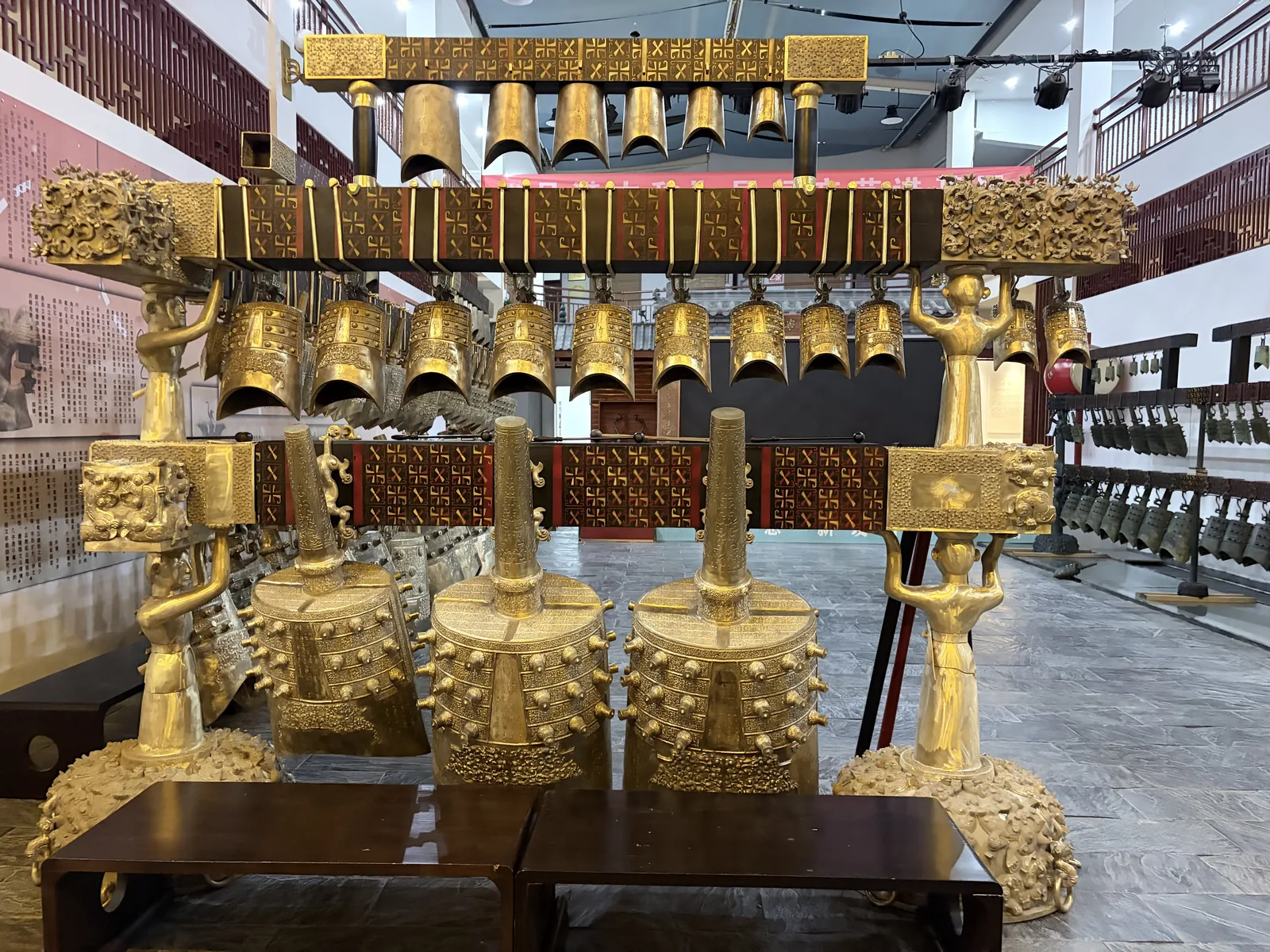
The photograph used on this page shows a large showroom arrangement with repeated bell bodies, decorative panels and sculptural supports. It is useful for discussing scale, repetition, frame design and visible surface direction. It does not prove that the display is an excavated historical set or that every displayed form has identical specifications.
Historical bianzhong versus a modern bronze bell reproduction
A historical bianzhong is an object or ensemble with a documented historical record. That record may include an excavation context, museum collection information, inscriptions, conservation notes, measurements or musicological research. A modern bronze bell reproduction is a made-today object that may borrow a historical silhouette, decorative language, arrangement or display concept without sharing the original age, provenance or ritual history.
CCLYF presents modern reproductions made today. The workshop showroom photo on this page is a first-hand visit record of displayed forms, not a claim that CCLYF owns the workshop, manufactures every catalog product there, or has completed a named bianzhong case for a customer. It is also not evidence that a modern bell has the sound, alloy or dimensions of a particular historical set.
| Information type | What can be discussed | What must be confirmed |
|---|---|---|
| Reference photo | Visible bell outline, decoration, frame direction, supports and available viewpoints. | Whether the photo is clear, complete and suitable for a reproduction brief. |
| Historical source | Named period, object terminology and source-specific interpretation. | Whether the source actually supports a claim about the reference object. |
| Modern project brief | Bell form, approximate scale, display purpose, finish direction, quantity and destination. | Material, exact dimensions, weight, sound requirements, price, MOQ, packaging and delivery timing. |
For the general stages of a modern bronze reproduction discussion, review the Bronze Casting Process guide. It explains a general reference-to-finish workflow and should not be read as a fixed process specification for every product or bell project.
How to start a custom Chinese bronze bell inquiry
A useful inquiry begins with a clear reference rather than a vague request for an ancient-looking bell. Send the best available photographs, drawings or physical-reference notes, then separate visible requirements from sound or installation requirements.
- Identify the direction. Say whether you are discussing one bell, a small group of Chinese chime bells or a larger bianzhong-style display.
- Share complete views. Include front, side, rear, upper and lower views where possible. A close-up of decoration or inscriptions can be useful, but it does not replace overall views.
- Describe the visual priorities. Note the body proportion, mouth shape, bosses, surface pattern, frame, supports and finish direction that matter most.
- Explain the intended setting. State whether the project is for a cultural display, interior, hotel, museum-style presentation, stage, collection or another setting.
- Separate sound from appearance. If the bell must be playable, state that as a project requirement. Visual similarity alone does not confirm pitch, tuning or safe installation.
- Leave quote-stage fields open. Material, exact dimensions, weight, price, MOQ, packaging, delivery timing and sample options should be confirmed case by case.
For reference-led projects, use the Custom Bronze Reproductions path and include the phrase bronze reproduction from photos if photographs are the starting point. CCLYF can review the visible direction first and then clarify which project details require a sample, technical discussion or quotation-stage confirmation.
Frequently asked questions
What does bianzhong mean?
Bianzhong is the Chinese term commonly used for a set or arrangement of suspended bronze bells, often discussed as ancient Chinese chime bells. The exact historical form and context depend on the named set or record.
Are all Chinese bronze bells part of a bianzhong?
No. A single Chinese bronze bell can be studied on its own. Bianzhong describes an organized bell ensemble or tradition, not every individual bell.
Can a photograph prove that a bell is ancient?
No. A photograph can show visible form, decoration and available views, but it cannot by itself prove age, excavation, provenance, authenticity, alloy or historical use.
Can CCLYF provide a bronze bell from photos?
A buyer can submit photos, drawings or a physical-reference description for a custom discussion. Feasibility, material, dimensions, sound requirements, sample options and quotation details are reviewed case by case.
Does a modern reproduction automatically sound like an ancient bell?
No. A visual reproduction and a playable instrument are different requirements. Pitch, tuning, wall profile, striking method, installation and performance need separate confirmation.
Sources and further reading
These resources provide broader historical and technical context. Their statements apply to the named source, object or teaching page and do not automatically classify current CCLYF products.
- The Metropolitan Museum of Art: Shang and Zhou DynastiesGeneral context for the Bronze Age transition and historical continuity.
- The Metropolitan Museum of Art: Ancient Chinese BronzesBackground for reading ancient Chinese bronze objects through form, ritual and material culture.
- Smithsonian National Museum of Asian Art: Piece-Mold CastingTechnical context for an important ancient Chinese bronze-casting tradition.
- Asian Art Museum: Casting Bronze VesselsEducational material for understanding how historical bronze casting is explained.
- Chinese Bronze Vessel TypesBroader vessel-form vocabulary and modern reproduction boundaries.