Quick answer: what is a Chinese bronze mirror?
A Chinese bronze mirror is a polished bronze object designed with a reflective front and a decorated back. Many historical examples are round, with a central knob or pierced fitting that could help with handling or suspension, while the reverse may carry patterns, animals, geometric bands, inscriptions or other ornament.
The phrase can refer to objects from different periods and regions. It is therefore better to describe the named mirror, its dated collection record and its visible features than to treat every Chinese bronze mirror as one fixed type.
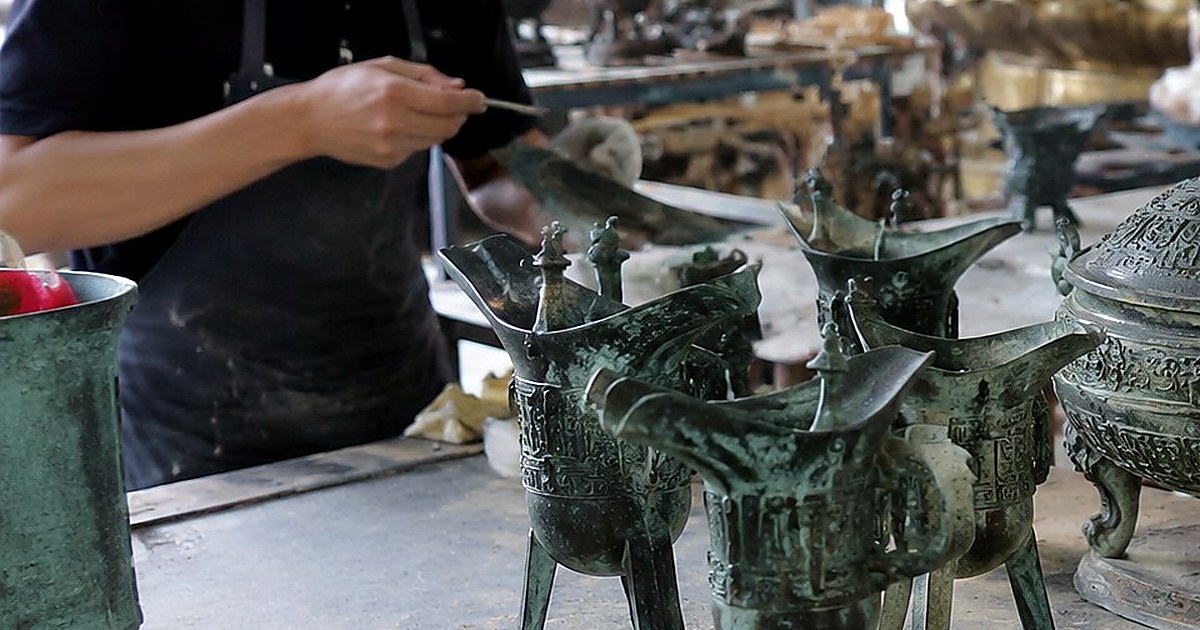
For CCLYF, this is a knowledge and custom-reference topic rather than a claim of current mirror inventory. The website currently presents modern Chinese bronze reproductions such as Jue cups, incense burners and animal-form vessels. A Chinese bronze mirror can be discussed as an additional reference-led direction, but the exact feasibility and quote details must be confirmed case by case.
What makes a bronze mirror different from a bronze vessel?
The most useful first distinction is the object's primary design role. A bronze vessel is usually read through a container body, opening, legs, handles, lid, spout or foot. A bronze mirror is read through a reflective face and a decorated reverse, often with a central knob or fitting.
| Question | Chinese bronze mirror | Chinese bronze vessel |
|---|---|---|
| What is the main visible surface? | A polished or reflective face and an ornamental back. | A body, opening, support, lid, spout, handles or other vessel structure. |
| What is often inspected first? | Shape, rim, central knob, reverse decoration and inscriptions. | Silhouette, legs, posts, handles, lid, spout, foot and proportion. |
| What can a photograph establish? | Visible shape, surface arrangement and available views. | Visible form, surface direction and available product-page evidence. |
| What still needs a source or quote? | Date, alloy, provenance, original use, exact size and reproduction specifications. | Date, material, provenance, exact dimensions, weight, price and delivery details. |
This comparison is a vocabulary aid, not an authenticity test. A similar round shape or decorative style does not prove that an object is an ancient mirror, a documented excavation find or a museum-certified reproduction.
Chinese bronze mirror history: a long and varied tradition
The history of Chinese bronze mirrors spans a long period, and surviving examples show changes in shape, surface design, inscriptions and cultural context. A single short history should be treated as an orientation rather than a complete chronology.
- Early development: Early mirrors were made from polished bronze and often used a decorated reverse to distinguish the object from a plain metal disk. The exact date and regional context belong to the individual collection record.
- Warring States and Han directions: Many discussions of ancient Chinese bronze mirrors focus on increasingly varied reverse patterns, inscriptions and organized geometric designs. The pattern family can help a reader compare examples, but it is not a stand-alone dating method.
- Tang and later reinterpretations: Later mirrors introduced or popularized additional decorative directions, including floral, animal and cosmological imagery in particular examples. The relevant meaning and chronology still need to be tied to a named source.
- Modern study and display: Museums, university collections and exhibitions now use bronze mirrors to explain technology, trade, design, social history and visual culture. A modern reproduction may borrow a form language without sharing the historical object's age or provenance.
The Huntington exhibition overview is useful for seeing the chronological breadth of Chinese bronze mirrors. The Metropolitan Museum of Art overview of Shang and Zhou provides wider Bronze Age context, but it should not be treated as a complete history of every later mirror type.
Chinese bronze mirror patterns: what can you see on the back?
Patterns on a Chinese bronze mirror are usually read from the reverse rather than the reflective face. Depending on the object, a viewer may encounter animals, birds, dragons, geometric bands, floral arrangements, linked arcs, inscriptions or designs associated with cosmological ideas.
Common pattern descriptions include:
- Animal and bird designs: These may include birds, dragons, serpentine forms or other creatures shown in a particular arrangement.
- Geometric organization: Repeated circles, linked arcs, quatrefoil-like structures, borders and other geometric units can organize the mirror back.
- Floral and plant forms: Some later examples are discussed through flowers, foliage and scrolling arrangements, but the date and meaning must remain source-specific.
- Inscriptions: Characters or short texts can provide important evidence for a named object, but they should be read from a reliable record or specialist study rather than guessed from a photograph.
- Central knob and surrounding zones: The knob, rim, bands and spaces around the center help a reader describe the composition before assigning a narrow interpretation.
The Bowers Museum discussion of early Chinese bronze mirrors is a helpful starting point for the contrast between a reflective front and a decorated reverse. The Australian Museum guide also explains why the round form and reverse decoration are important parts of the object's cultural and visual discussion.
What does a Chinese bronze mirror symbolize?
There is no single symbolism that applies to every Chinese bronze mirror. Some museum and cultural-institution explanations connect round mirrors with ideas such as completeness, reunion, brightness or good fortune, while individual designs may invite different readings based on their inscriptions, animals, flowers, cosmological references or historical context.
The careful answer to Chinese bronze mirror meaning is therefore source-specific. A round shape can support a cultural association, but it does not prove that every historical owner used the mirror for one identical purpose. A dragon, bird, floral pattern or inscription also needs to be read through the named object and its record.
When a buyer asks about symbolism for a gift or interior project, it is safer to distinguish three levels:
- Visible description: What shape, knob, rim, pattern or inscription can actually be seen?
- Source-supported interpretation: What does a museum, catalogue or specialist source say about this named example?
- Contemporary design use: What visual or cultural association does the buyer want the modern object to communicate?
This distinction prevents a broad internet explanation from becoming an unsupported promise about history, ritual use or fixed auspicious meaning.
How to examine a Chinese bronze mirror from photographs
A photograph can help identify a visual direction, but it should be treated as the beginning of research. For a museum object, compare the image with the institution's record. For a custom reproduction discussion, organize the reference views before asking for a quote.
- Show both sides. A front view and a reverse view are essential because the mirror face and the decorated back answer different questions.
- Record the outline. Note whether the object is round, lobed, polygonal or another documented shape. Do not infer a period from outline alone.
- Inspect the center. Describe the knob, hole, fitting or central structure without assuming its exact historical function.
- Map the reverse decoration. Separate the center, inner field, border and rim. This makes pattern comparison more precise.
- Check inscriptions carefully. Use a clear close-up and a reliable transcription. A low-resolution image is not enough to identify characters or meaning.
- Ask for scale. Include a ruler or confirmed dimensions when the request concerns a modern reproduction. Exact size, weight and material remain quote-stage information.
- Separate the object from the claim. A similar pattern does not establish that the reference is ancient, excavated, authentic or museum-certified.
For the wider vocabulary of body, opening, support, lid, handles and surface evidence, compare the Chinese Bronze Vessel Types guide. For period comparison, see Shang vs Zhou Bronze Vessels.
Historical mirror versus modern bronze reproduction
A historical Chinese bronze mirror and a modern bronze mirror reproduction may share a circular outline or a decorative reference, but they are not the same category of object. The historical object may have a documented date, collection history, inscription, excavation context or conservation record. A made-today reproduction needs its own product description and quote-stage confirmation.
CCLYF uses modern-reproduction wording carefully. This new article does not present a current Chinese bronze mirror catalog, does not claim museum provenance and does not describe an unconfirmed mirror as a historical artifact. The same boundary applies when a buyer sends a reference photograph from a museum, auction listing, family collection or online image.
| Information type | What can be discussed | What must be confirmed |
|---|---|---|
| Reference image | Visible outline, reverse pattern, knob, rim and available viewpoints. | Whether the image is clear enough to reproduce and whether all views belong to the same object. |
| Historical source | Named period, catalogue terminology and source-specific interpretation. | Whether the source actually supports the claim being made. |
| Custom request | Form direction, approximate scale, finish preference, quantity and destination. | Material, exact dimensions, weight, price, MOQ, packaging and delivery timing. |
For a broader explanation of this wording boundary, read Modern Reproduction Clarity. For general process vocabulary, see the Bronze Casting Process guide; it describes a general process and is not proof of the undocumented route for a particular mirror.
Can CCLYF discuss a custom Chinese bronze mirror?
Yes. CCLYF can discuss a Chinese bronze mirror as a directory-outside reference when the buyer provides enough visual and project information for a case-by-case review. The request should be framed as a modern reproduction or custom bronze object conversation, not as a request for an authenticated historical original.
Useful starting materials include front and back photographs, close-ups of the reverse pattern, a side or edge view, approximate dimensions, quantity range, destination, intended display or gifting use and the preferred surface direction. A drawing or physical reference may also help, subject to what can be confirmed during the quote process.
The Custom Bronze Reproductions page is the correct commercial handoff. It explains how to begin with photos, drawings or a physical reference. The Workshop page provides sourcing and visit context, but neither page should be read as proof that every pictured object is a current mirror product or that every requested specification is already confirmed.
Questions to include in a custom mirror inquiry
A clear inquiry reduces avoidable back-and-forth. Include:
- The front and reverse reference photos, with the best available close-ups.
- The approximate diameter, thickness or display scale, if known.
- The pattern, inscription or central knob details that matter most.
- The requested quantity range and destination country.
- The intended use: display, cultural gift, interior project, exhibition reference or another purpose.
- The preferred surface direction, such as a brighter polished look or an aged-style visual reference, without assuming a specific finish is available.
- The details that must be confirmed before ordering, including material, exact dimensions, weight, price, MOQ, packaging and delivery timing.
Use the Request Quote path when the reference package is ready. CCLYF will need to confirm the current sample path and quote-stage information rather than infer them from the photograph.
Frequently asked questions
What is a Chinese bronze mirror?
It is a bronze mirror with a reflective front and a decorated reverse, often including a central knob or fitting. The exact date, form and meaning depend on the named object and source.
What patterns appear on Chinese bronze mirrors?
Examples may include animals, birds, dragons, geometric bands, flowers, inscriptions and other organized reverse decoration. The pattern list is a starting point, not a complete classification.
What does a Chinese bronze mirror symbolize?
Some sources connect round mirrors with ideas such as completeness, reunion, brightness or good fortune, but symbolism is not identical for every object. Use the named source before making a specific claim.
Does CCLYF sell Chinese bronze mirrors?
CCLYF does not currently present a Chinese bronze mirror as a listed catalog product. A modern custom reproduction discussion may be possible from photos, drawings or a physical reference, subject to case-by-case confirmation.
Can a modern bronze mirror reproduction be called a historical original?
No. A made-today reproduction should be described as a modern reproduction or custom bronze object unless separate evidence supports another claim. Similar appearance does not establish age, excavation, authenticity or provenance.
Sources and further reading
These resources describe named historical objects, exhibitions or educational context. They are not evidence that CCLYF currently stocks a Chinese bronze mirror or that a modern custom request has already been approved.
- Australian Museum: Chinese Bronze MirrorsOverview of mirror form, reflective surface, decoration and cultural context.
- The Huntington: Ancient Chinese Bronze Mirrors from the Lloyd Cotsen CollectionExhibition context for a collection spanning multiple periods.
- Bowers Museum: Reflections on Early Chinese Bronze MirrorsEducational discussion of the reflective front and decorated reverse.
- The Metropolitan Museum of Art: Shang and Zhou DynastiesBroader historical context for early Chinese bronze culture.
- Chinese Bronze Vessels: Types, Forms and Ritual ContextBroader vessel terminology and visual identification limits.
- Modern Reproduction ClarityHow to separate current reproduction evidence from historical-origin claims.