
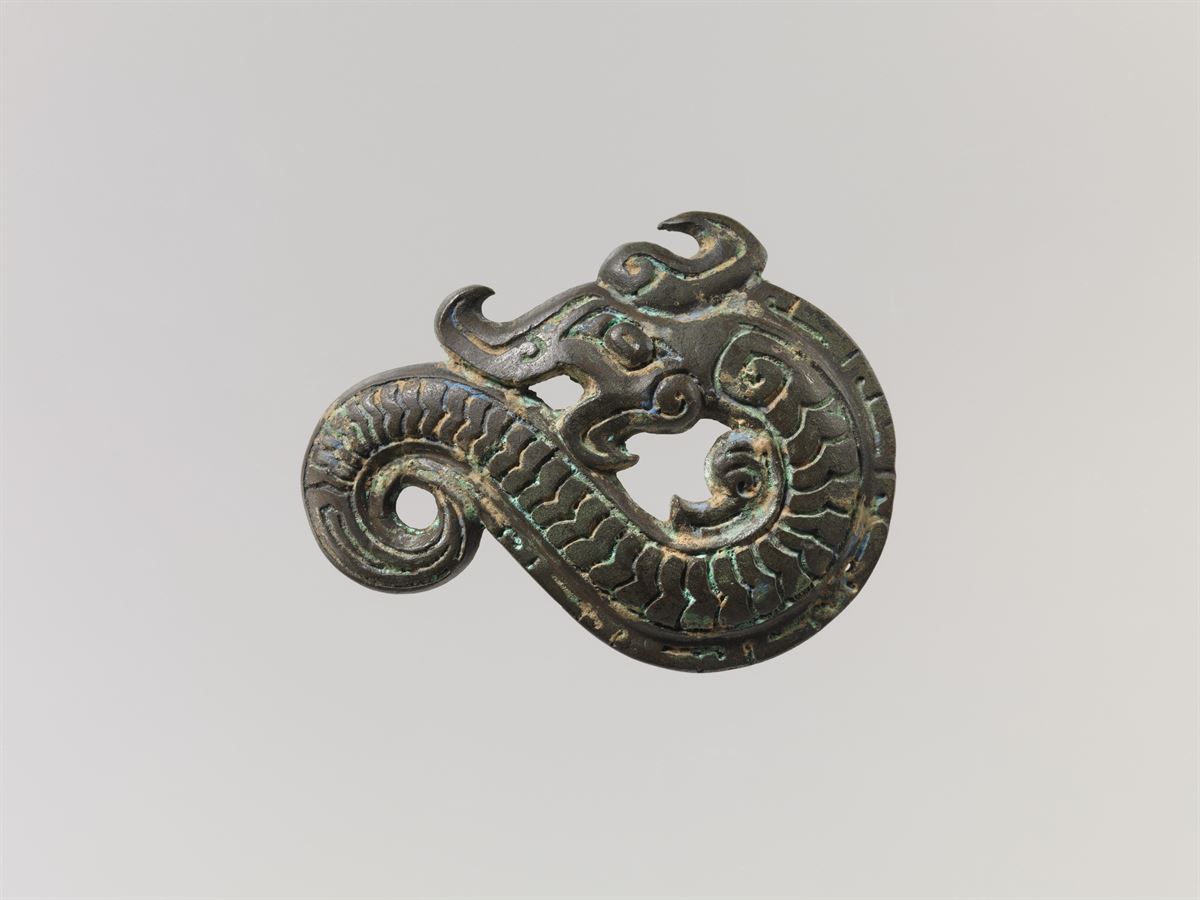
Quick answer: What is Chinese dragon art?
Chinese dragon art refers to dragon imagery in Chinese artistic traditions. On bronze objects, a dragon may appear as a separate ornament, a freestanding figure or a feature integrated into a vessel. The motif also appears in other media, but each object and period has to be read on its own terms.
There is no single Chinese dragon meaning or silhouette that fits every period and object. Start with the named object, describe what is visible, and then check how a museum, catalogue or other reliable source identifies and interprets that specific example.
This page focuses on documented bronze examples. It does not present a bronze dragon as a current catalog product, and the historical museum objects shown here are not CCLYF products or production samples.
How can you recognize a dragon in Chinese art?
Describe the full form and its relationship to the surrounding object before assigning a narrow label. A dragon image may show an elongated or curling body, a distinct head, a raised neck, limbs, a tail or surface details such as scales; some examples emphasize only the head, and not every feature appears on every object.
Placement changes the visual role. A dragon-form appliqué is a separate applied element, a dragon-head spout is part of a vessel, and a freestanding figure is catalogued as sculpture. A photograph can show these visible relationships, but it may not establish an object's original function or historical identity.
| Visible clue | What it helps describe | What it does not prove alone |
|---|---|---|
| Head, mouth, horns or body | The visible shape and posture of the dragon form. | A date, identity, owner or symbolic meaning. |
| Relief or separate attachment | Whether the form sits on a surface or is applied to another object. | Original use, provenance or authenticity. |
| Vessel position | Whether the dragon appears at a spout, handle, lid or body. | One universal ritual role for every object. |
| Freestanding modeling | Pose, body volume and the way a figure occupies space. | That another similar-looking object has the same catalogue identification. |
Three ways dragons appear on bronze objects
Museum records document different roles for dragon imagery: a compact applied ornament, a small three-dimensional figure and a vessel feature. The examples below illustrate those distinctions; they are not a complete survey of Chinese dragon art.
1. A separate dragon-form ornament
The Metropolitan Museum of Art catalogues Appliqué in the Form of a Dragon as a bronze object from China dated to the 13th-11th century BCE. Its record identifies the compact object as an appliqué in the form of a dragon, rather than as a complete vessel or a large freestanding statue.
2. A small three-dimensional bronze dragon
The Met's Dragon, object 30.37.2, is a gilt-bronze sculpture dated to the 7th century. The museum describes it as a dragon in a walking posture and notes that some feet are missing. The catalogue description gives both an object identification and a condition detail; it does not require the photograph to prove more than the record supports.
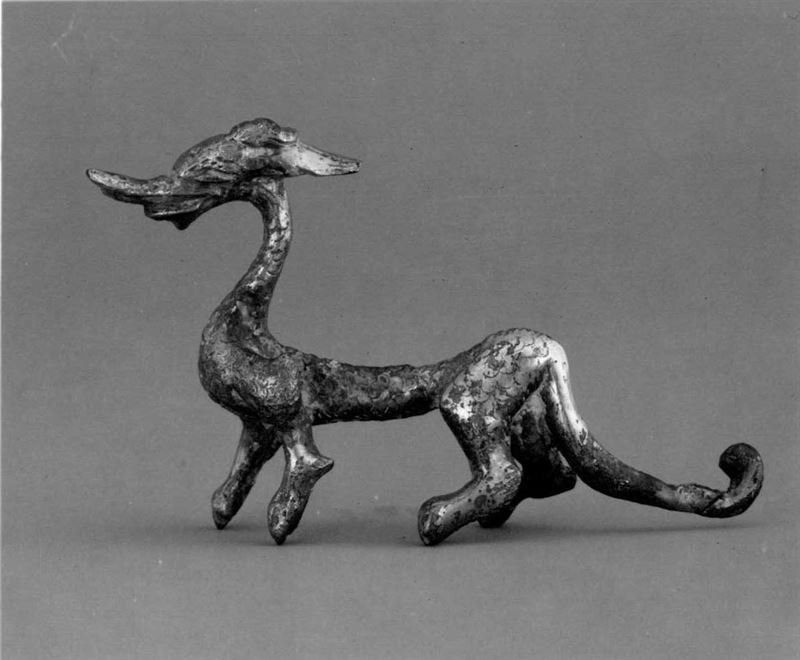
This example is a sculptural subject in its own right. It is different from an animal motif attached to a larger object, even though both may be described as dragon forms.
3. A dragon head that shapes a vessel feature
The Met's Spouted Tripod Vessel with Dragon's Head (Jiaodou), object 2025.829.3, is a gilt-bronze vessel dated to the 3rd century and assigned to the Western Jin dynasty. Here, the dragon head forms part of the spout rather than standing alone as a separate sculpture.
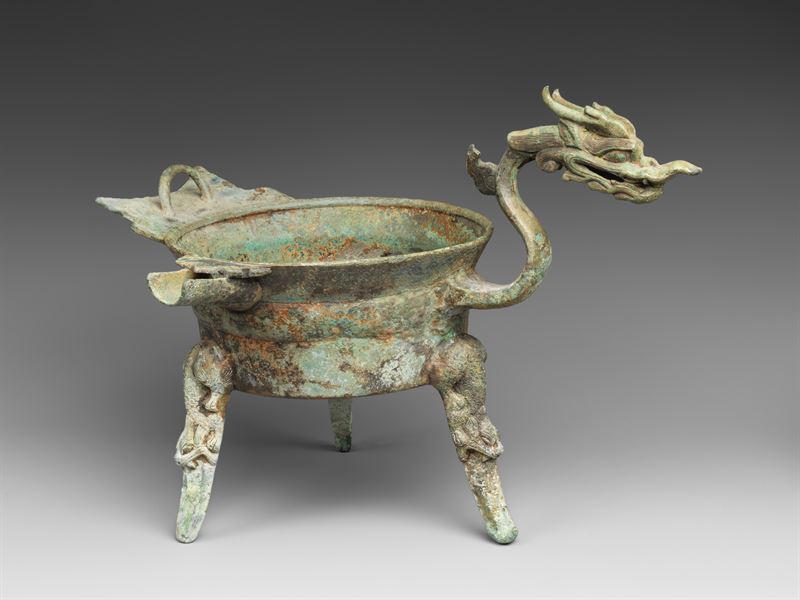
The museum record says historical texts describe this type of vessel as being used for cooking food or heating water. That explanation belongs to the named vessel type and its cited record; it should not be generalized to every dragon-shaped bronze.
What does a Chinese dragon symbolize?
Chinese dragon symbolism depends on the named object, its period, its source record and its context. The Met's note for a Han-period Finial in the Shape of a Dragon Head describes the dragon as an auspicious emblem of nature's creative forces. A separate Met record for a Qing porcelain vase discusses associations including protection, happiness, fertility, water, the east and imperial rule in particular contexts.
These are source-backed readings, not a universal code for every dragon. The Met's discussion of a five-clawed dragon connects that example with works made for court use; it does not mean that any five-clawed image proves an object's original owner, date or court status.
Keep the source's level of certainty attached to the specific object. "The museum identifies this named object as a dragon" is different from "the image may refer to a particular idea." A motif alone cannot prove a universal meaning, date, ritual use or provenance.
Chinese dragon art is not limited to bronze
Dragon imagery also appears in other media. The Met catalogues Vase with Dragon amid Clouds as a Qing-dynasty porcelain object from the Yongzheng period. Its dragon is painted on the vessel rather than modeled as a bronze figure or built into a metal spout.
This is one documented example of the motif appearing across media, not a complete survey of Chinese dragon painting, ceramics, textiles or architecture. For a broader introduction to sculptural animal forms, see the Chinese bronze sculpture guide.
Dragon, dragon-head feature or Taotie motif?
A dragon may be represented as a complete animal, a separate sculpture or a dragon-head detail. Taotie usually describes a face-like decorative motif on an object, not automatically a complete dragon figure. Complex animal forms can overlap visually, so use the name given by the relevant museum or catalogue when one is available.
See the Taotie motif guide for a source-aware explanation of face-like bronze decoration. A shared visual feature does not make two object types identical.
How to read a Chinese dragon image responsibly
A reliable description separates visible observations from catalogue identification and interpretation. Before repeating a claim about a dragon on an object, check these five points:
- Object name: Does the source call it a dragon, dragon head, appliqué, vessel or sculpture?
- Date and period: Does the date apply to this exact object, and is it approximate?
- Visible form: What can actually be seen, including missing, hidden or unclear details?
- Placement: Is the dragon a surface motif, an applied element, a separate figure or part of a vessel feature?
- Interpretation: Does the source state a fact, offer a possibility or leave the identification open?
A museum record documents the object it identifies. It does not automatically date, authenticate or explain another object with a similar appearance. Image rights are separate from historical interpretation, so check the individual image record before reusing a museum photograph.
For period-specific vessel context, continue to Chinese Bronze Vessel Types and Shang vs Zhou Bronze Vessels.
Can you ask about a modern bronze dragon reproduction?
CCLYF does not currently list a bronze dragon as a standard catalog product. Buyers can submit photographs, drawings, a museum reference or a physical model to discuss a modern custom-reproduction direction. An inquiry is a request for review, not confirmation of availability or exact reproduction.
CCLYF coordinates custom discussions with a long-established Chinese bronze production partner whose production-side experience spans more than 30 years, including model development, casting and hand finishing. This describes partner-side experience; it does not mean that CCLYF owns the production facility or that every project follows one identical process. The Bronze Casting Process guide explains a general process, not a fixed specification for a particular dragon design.
For a useful first discussion, share the reference source, available views, approximate target dimensions if known, intended display setting, quantity and the details that matter most. Material, exact dimensions, weight, finish, sample options, feasibility, price, minimum order, packaging and delivery timing must be reviewed case by case.
Start with Custom Bronze Reproductions or Request a Quote. A historical image can guide a design discussion; it does not make a new object an ancient original or establish museum provenance.
Frequently asked questions
What is the meaning of Chinese dragon art?
Chinese dragon art carries different associations across objects and periods. Museum sources discuss ideas such as auspiciousness, water, protection and imperial rule in specific contexts, but no single meaning should be assigned to every dragon image.
Are all Chinese dragons imperial symbols?
No. The Met discusses imperial use in connection with particular works and court contexts. A dragon motif by itself does not prove an object's original owner, rank, date or setting.
Do Chinese bronze vessels show dragons?
Yes. Museum records document bronze objects with dragon-form ornaments, sculptural figures and dragon-head vessel features. Each named object should be read through its own catalogue record.
Is every dragon-like bronze motif a Taotie?
No. A dragon figure and a face-like Taotie motif are different descriptive categories, although a design can be complex. Follow the terminology and evidence in the source for the object being discussed.
Can I buy a bronze dragon statue from CCLYF?
A bronze dragon is not currently listed as a standard catalog item. You can submit a reference to discuss a modern custom-reproduction direction; feasibility and commercial details are reviewed case by case.
Sources and image credits
These records support statements about the named objects and their published interpretations. They do not automatically identify or authenticate other objects.
- The Metropolitan Museum of Art: Appliqué in the Form of a Dragon, object 1985.214.39Bronze dragon-form appliqué, China, 13th-11th century BCE. Image marked Public Domain.
- The Metropolitan Museum of Art: Dragon, object 30.37.2Gilt-bronze dragon sculpture, China, 7th century. Image marked Public Domain; the downloaded photograph is grayscale.
- The Metropolitan Museum of Art: Spouted Tripod Vessel with Dragon's Head (Jiaodou), object 2025.829.3Gilt-bronze vessel, Western Jin dynasty, 265-316. Image marked Public Domain.
- The Metropolitan Museum of Art: Finial in the Shape of a Dragon Head, object 1992.165.25Object-specific source for one interpretation of a dragon-head finial.
- The Metropolitan Museum of Art: Vase with Dragon amid Clouds, object 32.100.434Qing-dynasty porcelain example and source-specific symbolism discussion. Image marked Public Domain; its image is not used on this page.
- Smithsonian National Museum of Asian Art: Spouted Ritual Vessel (He) with Dragons, object F1942.1a-bCited for the written object description and interpretive uncertainty only. The photograph is not reused because its record lists Usage Conditions Apply.